Research · Narrative Translation
Capitulation vs Bottom: Reading Bitcoin’s Structure

In Our Strategy, capitulation is not defined by headlines or emotion. It is defined by mechanics.
The recent Bitcoin selloff fits a familiar pattern: leverage-driven liquidation compressing downside
into a short window, creating extreme dislocation from trend and sentiment.
What the Video Is Actually Claiming
The reviewed analysis argues that Bitcoin has experienced a historic capitulation event, marked by
record dollar-value drawdowns, extreme oversold conditions relative to long-term moving averages,
and panic-level sentiment. The claim is not that a new bull market has begun, but that probabilities
favor a strong relief rally.
Forced Selling vs Discretionary Selling
Forced selling matters because it is non-economic. Liquidations occur regardless of valuation,
narrative, or conviction. When leverage unwinds, price overshoots. This is why capitulation phases
often produce sharp bounces even inside broader corrective regimes.
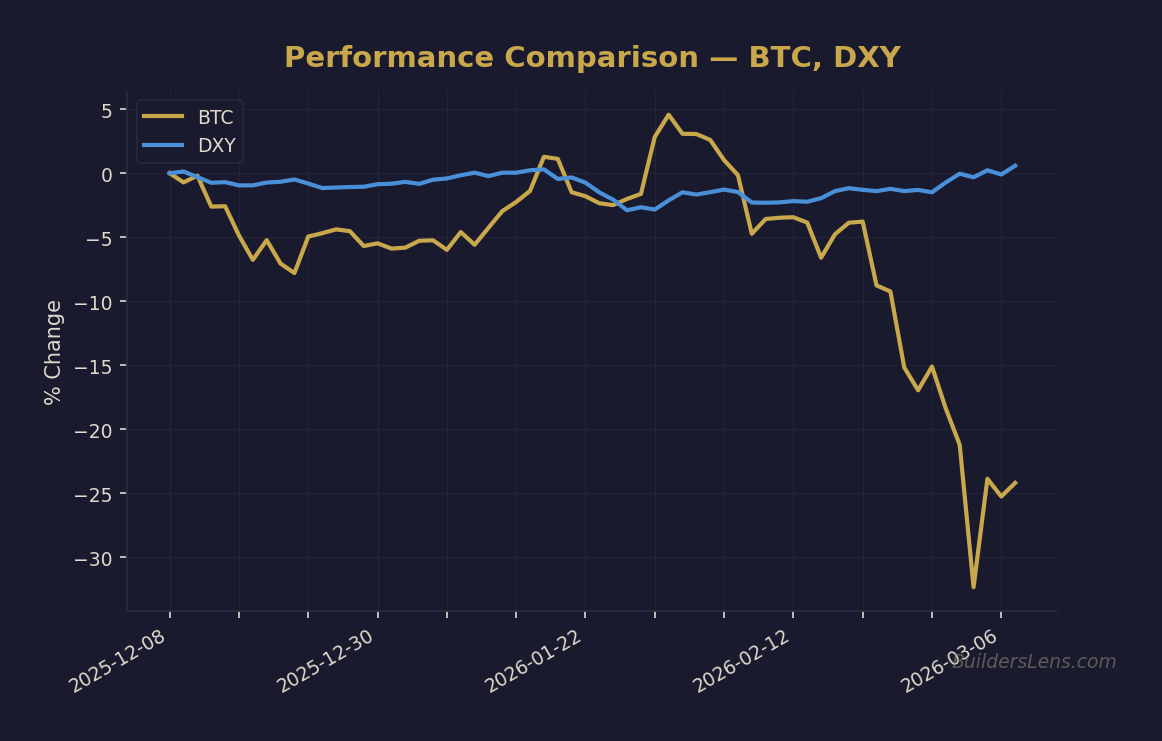
Source: BuildersLens.com Signal Framework | Data as of March 08, 2026
Mean Reversion Is a Mechanism, Not a Forecast
Bitcoin recently reached nearly three standard deviations below its 200-day moving average.
Historically, such extensions are rare. Mean reversion does not guarantee trend reversal—but it
increases the probability of counter-trend movement as positioning resets.
Phase Mapping in Our Strategy
This behavior aligns most closely with a late Phase-2 environment in Our Strategy framework.
Forced liquidation has occurred, but systemic credit stress remains contained. That combination
favors relief rallies rather than immediate structural recovery.
- Current phase continuation (Phase 2): ~55%
- Transition to Phase 3 later in 2026: ~30%
- Early Phase-3 escalation before mid-2026: ~15%
Liquidity, Dollar Risk, and Confirmation
Global liquidity indicators have stabilized, not surged. This reduces immediate downside pressure
but does not yet support sustained upside. Dollar strength remains the primary invalidation risk;
renewed dollar acceleration would pressure risk assets broadly.
What Changes
- Downside pressure from forced selling has likely eased
- Mean-reversion probability has increased
- Short-term relief scenarios now dominate tail-risk scenarios
What Does Not Change
- This is not confirmation of a new cycle
- Structural macro risks remain unresolved
- Risk discipline and confirmation remain essential
Signals We Continue to Monitor
- Weekly closes relative to prior range resistance
- Dollar trend and global funding conditions
- Volume participation during rebounds
- Credit and rates behavior across risk assets
Invalidation Conditions
A rapid resurgence in dollar strength, failed relief rallies with expanding volume to the downside,
or renewed leverage build-up without liquidity support would invalidate the relief-dominant
probability path.
Get the Daily Phase Brief
Signal changes, data releases to watch, and today’s regime assessment — delivered every morning before market open.
Join investors tracking the macro cycle. Unsubscribe anytime.
📊 Run Your Own Analysis
Use the BuildersLens 65-Signal Analyzer to see live macro positioning for tickers mentioned in this article:
This article is for educational and informational purposes only and does not constitute investment advice. Past performance is not indicative of future results. Consult with a qualified financial advisor before making investment decisions.