Research · Market Internals
COMEX Silver Isn’t Just a Metal Story — It’s a Settlement Story

COMEX Silver Isn’t Just a Metal Story — It’s a Settlement Story
In Our Strategy, we treat “silver squeeze” narratives as a market-structure hypothesis, not a forecast. The current discussion around COMEX silver is not primarily about price targets. It is about clearing mechanics, delivery behavior, and whether the structure of the market is being stress-tested.
We are not trying to predict an outcome. We are mapping mechanisms. When paper claims grow faster than deliverable supply, the variable that matters most is behavior.
Paper Settlement vs Delivery Optionality
Futures markets are designed to settle financially. The majority of contracts never result in physical delivery. This is normal. Liquidity depends on it.
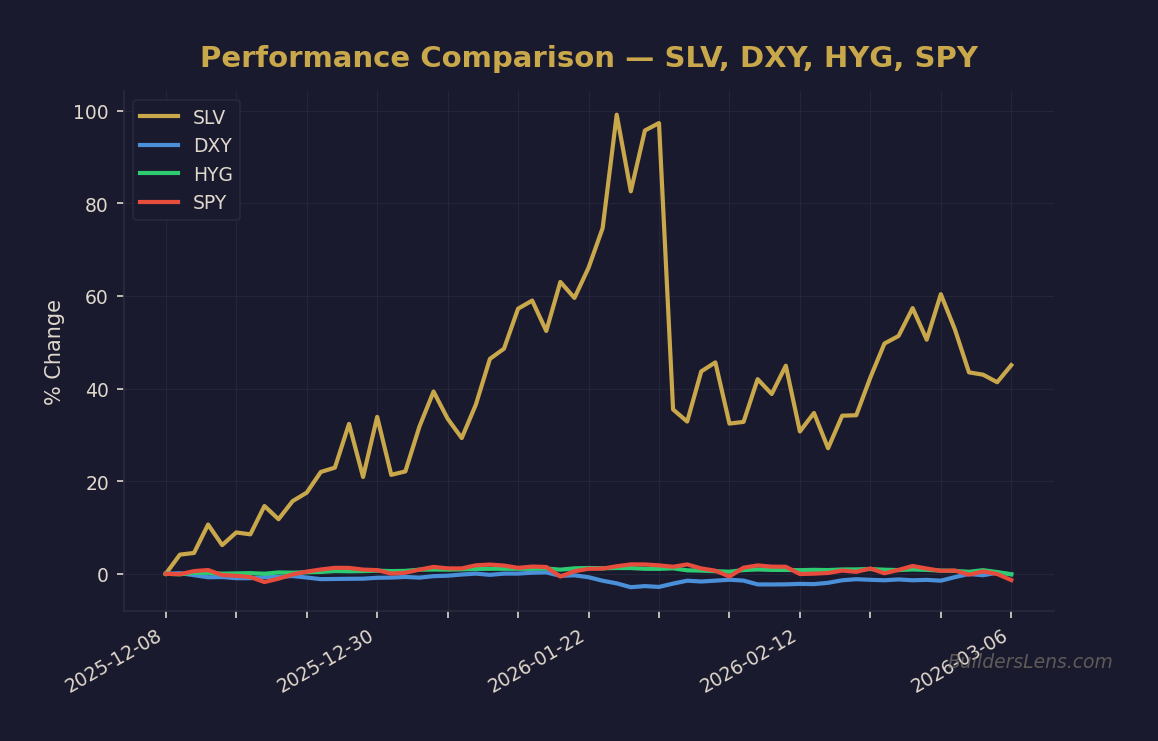
Source: BuildersLens.com Signal Framework | Data as of March 08, 2026
The system functions smoothly because only a small percentage of participants ever demand metal. If that percentage remains stable, the paper market can scale far beyond physical inventories.
The stress signal emerges when that behavioral assumption changes.
Registered vs Eligible — Why the Distinction Matters
COMEX warehouse reports distinguish between registered and eligible inventory.
- Registered: Metal tagged and available for delivery.
- Eligible: Meets specifications but is not pledged for delivery unless the owner converts it.
Total inventory figures can appear large. Deliverable inventory can be meaningfully smaller. During delivery months, the registered category becomes the constraint variable.
This distinction is not narrative. It is mechanical.
Lease Rates as a Tightness Signal
Silver lease rates represent the cost of borrowing physical metal. Elevated rates indicate tighter lendable supply or short-term dislocation in bullion lending markets.
A high lease rate does not guarantee a price move. It signals friction. When borrowing becomes expensive, short positioning costs rise and physical tightness becomes measurable.
Persistence matters more than spikes. A brief elevation can normalize. Sustained elevation implies structural constraint.
Delivery Windows as Behavioral Checkpoints
First notice day marks the point when contract holders must declare whether they intend to take delivery.
Most delivery cycles pass without incident because financial settlement dominates. The variable we monitor is whether the percentage standing for delivery increases across multiple cycles.
If delivery demand rises while registered inventories decline, the exchange’s response function becomes central.
The Exchange Response Function
When pressure rises, exchanges have tools:
- Margin increases
- Position limits
- Delivery requirement adjustments
- Cash settlement pathways
Historically, rule adjustments often occur during periods of rapid upside volatility. That does not imply misconduct. It reflects venue stability priorities.
In Our Strategy, the key question is not “will silver rise?” It is “how will the venue clear under pressure?”
Phase Mapping Within Our Framework
This type of dislocation aligns most closely with late Phase 1 transitioning toward Phase 2 conditions.
- Phase 1: Controlled risk-on, liquidity intact.
- Phase 2: Compression, internal fragility rising.
- Phase 3: Credit stress and forced liquidity events.
We are not asserting a Phase 3 event. We treat metals plumbing stress as a pressure marker. If it spreads across funding, credit, and collateral markets, probabilities shift.
Probability Sequencing Through June 2027
Now through June 2026
- Base Case 60 percent: Delivery stress episodic. Exchange clears through tighter terms without structural break.
- Alternative 30 percent: Persistent inventory tightness drives volatility and recurring dislocations.
- Tail Risk 10 percent: Credibility event tied to delivery constraints.
June 2026 through December 2026
- Base Case 55 percent: Market adapts through inventory conversion and higher borrowing incentives.
- Alternative 35 percent: Physical premiums persist across venues.
- Tail Risk 10 percent: Policy or export constraints amplify tightness.
December 2026 through June 2027
- Base Case 50 percent: Elevated volatility regime without systemic failure.
- Alternative 35 percent: Structural supply deficit sustains delivery optionality repricing.
- Tail Risk 15 percent: Broader funding stress intersects with commodity collateral markets.
These are process probabilities, not price forecasts.
What Changes — and What Does Not
What Changes
- Elevated monitoring of delivery behavior.
- Higher attention to lease rates and borrowing costs.
- Increased sensitivity to exchange rule responses.
What Does Not Change
- No anchoring to single dates.
- No straight-line outcome assumptions.
- No concentration risk based on narrative conviction.
- No escalation without confirmation.
Monitoring Dashboard
- Registered vs eligible inventory trends.
- Delivery percentage across multiple cycles.
- Lease rate persistence versus mean reversion.
- Physical premium behavior across regions.
- Exchange margin and rule adjustments.
- Credit spreads and funding conditions.
- Dollar strength and front-end yield movements.
Invalidation Criteria
- Registered inventories stabilize or rebuild.
- Lease rates normalize sustainably.
- Physical premiums compress.
- Delivery cycles pass without structural stress signals.
When confirmation fails, probabilities revert.
Conclusion
Silver tightness narratives can be emotionally charged. Our approach remains structural.
Markets do not break suddenly without prior compression. If delivery optionality is being repriced, it will show up first in inventories, borrowing costs, and venue behavior.
We do not need to predict the outcome. We need to observe the sequence.
Educational Notice: This content is for educational and analytical purposes only. It does not constitute investment advice.
Get the Daily Phase Brief
Signal changes, data releases to watch, and today’s regime assessment — delivered every morning before market open.
Join investors tracking the macro cycle. Unsubscribe anytime.
📊 Run Your Own Analysis
Use the BuildersLens 65-Signal Analyzer for live macro positioning:
→ Analyze HYG (High Yield Credit)