Research · Uncategorized
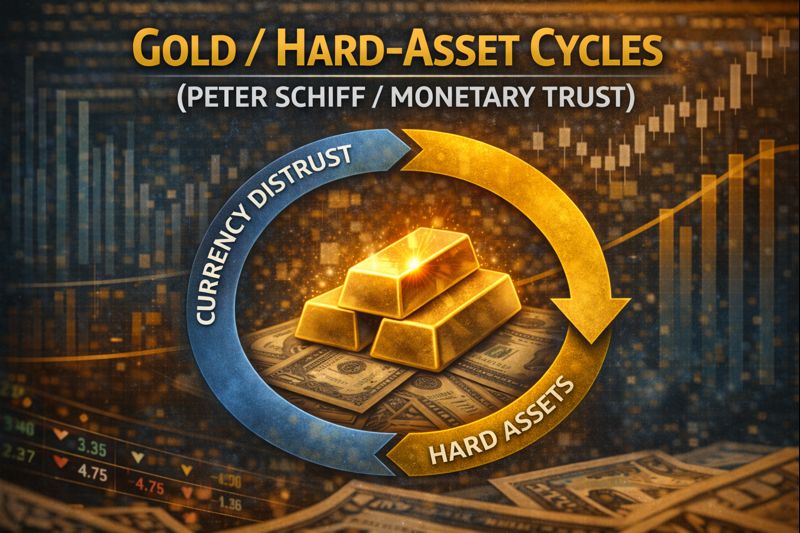
Gold / Hard-Asset Cycles (Peter Schiff / Monetary Trust)
Gold & Hard-Asset Cycles
Why Monetary Trust Assets Activate Late — Not Early
Gold is one of the oldest financial assets in human history —
and one of the most emotionally debated.
Advocates like Peter Schiff are often portrayed as “always bearish,”
yet their core argument is frequently misunderstood.
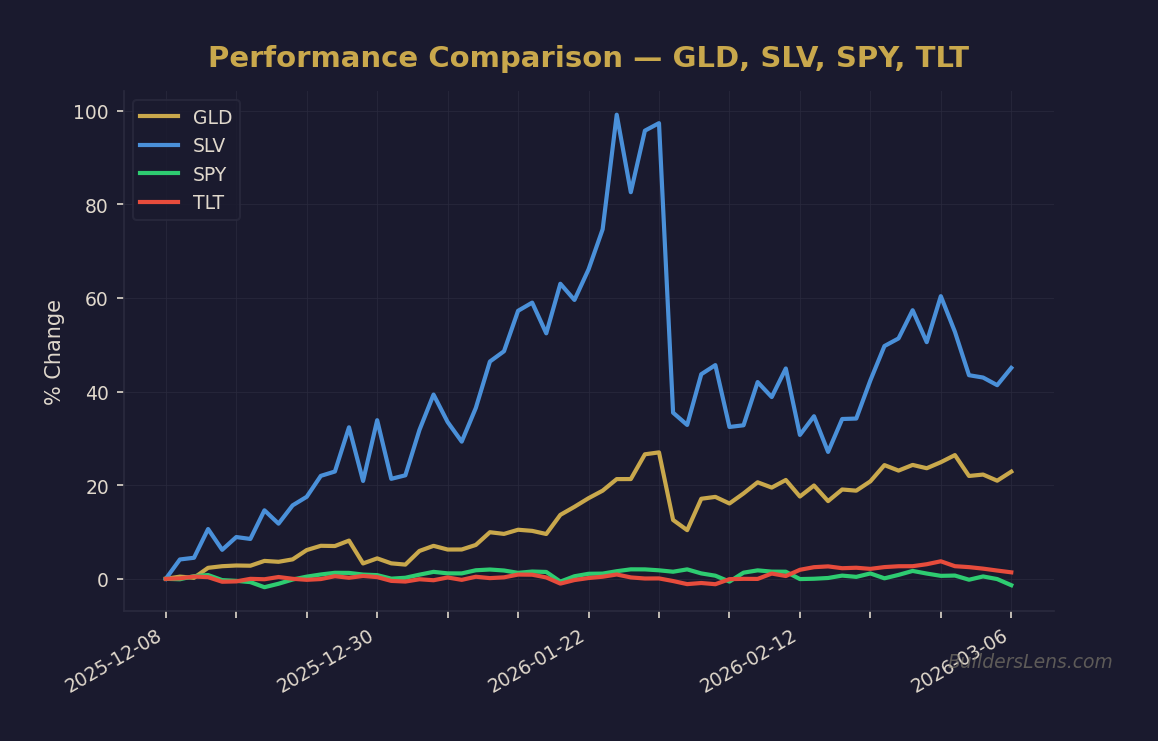
Source: BuildersLens.com Signal Framework | Data as of March 08, 2026
At BuildersLens, we separate monetary trust from
market timing.
Gold belongs firmly in the former.
What Are Hard Assets? (Plain English)
Hard assets are assets that:
- Cannot be printed or easily created
- Exist outside the financial system
- Retain value across regimes
Examples include:
- Gold and silver
- Energy and commodities
- Land and real assets
Gold, in particular, functions less like an investment
and more like a monetary reference point.
What Gold Is — and What It Is Not
Gold is often described as:
- An inflation hedge
- A crisis hedge
- A safe haven
Each of these descriptions is partially true —
and dangerously incomplete.
Gold does not reliably perform:
- During early inflation
- During liquidity-driven selloffs
- When cash is in high demand
Gold performs best when:
Confidence in monetary policy and financial promises begins to erode.
Why Gold Often Disappoints Early
One of the most common frustrations with gold is that:
It often falls during market stress.
This is not a failure.
In early and mid-cycle stress:
- Liquidity matters more than trust
- Cash is preferred
- Assets are sold indiscriminately
Gold is still a market asset.
It can be sold to meet margin calls.
Where Gold Fits in the Five Phases
Phase 0 — Post-Crisis Expansion
In Phase 0:
- Trust in policy is high
- Risk appetite improves
- Gold is often ignored
Opportunity lies elsewhere.
Phase 1 — Melt-Up / Liquidity Illusion
In Phase 1:
- Risk assets outperform
- Gold may lag or move sideways
- Hard-asset narratives feel premature
This is where gold advocates often sound “early.”
Phase 2 — Crack Formation / Rolling Stress
In Phase 2:
- Gold becomes volatile
- Liquidity pressures cause drawdowns
- Confidence in financial assets weakens unevenly
Gold is not yet the solution —
but it is no longer irrelevant.
Phase 3 — Forced Liquidation
Phase 3 often includes:
- Initial selling of gold for liquidity
- Policy responses that escalate rapidly
- Loss of confidence in financial stability
This is the transition point.
Gold begins to shift from:
“Just another asset” → “A monetary alternative”
Phase 4 — Reset / Accumulation
Phase 4 is where gold and hard assets matter most.
- Policy credibility is questioned
- Real rates remain suppressed
- Monetary trust is rebuilt slowly
Gold performs best not during panic —
but during the rebuilding of trust.
Where We Are Today
In the current environment, gold has shown
both strength and frustration.
This reflects its position in the cycle:
- Liquidity still dominates in stress events
- Policy credibility is questioned but not broken
- Hard assets are not yet the primary refuge
In Five Phases terms:
Gold’s behavior aligns with late Phase 1 into Phase 2 —
where monetary trust concerns are forming,
but liquidation still rules.
This is exactly where gold often underperforms expectations —
before becoming relevant later.
What Gold Can — and Cannot — Tell Us
Gold helps answer one question:
Is confidence in fiat systems beginning to erode?
It cannot:
- Time market crashes
- Outperform during liquidity squeezes
- Replace cash in early stress
Gold is not a trading signal.
It is a trust signal.
Final Takeaway
Gold is often misunderstood because it is judged by the wrong standard.
- It is not an early-cycle hedge
- It is not a panic asset
- It is a late-cycle trust asset
Within the Five Phases framework,
gold does not protect against volatility.
It protects against the loss of confidence
that follows volatility.
Get the Daily Phase Brief
Signal changes, data releases to watch, and today’s regime assessment — delivered every morning before market open.
Join investors tracking the macro cycle. Unsubscribe anytime.
📊 Run Your Own Analysis
Use the BuildersLens 65-Signal Analyzer for live macro positioning:
This article is for educational and informational purposes only and does not constitute investment advice. Past performance is not indicative of future results. Consult with a qualified financial advisor before making investment decisions.