Research · Narrative Translation
Gold Is Rising With Stocks. Here’s What That Really Signals

Gold’s “Paradox” Is the Signal: Instability Pricing Without Immediate Risk-Off
This source video argues that gold is in a structural upcycle driven by three forces: debasement, central-bank buying, and a retail participation gap. Our Strategy agrees on the mechanism categories, but we translate them through sequencing. The key point is not whether a headline forecast is right. The key point is which mechanism dominates in which phase, and what would confirm or invalidate the move when liquidity tightens.
When gold rises alongside equities, we treat it as an informational regime: markets can be pricing liquidity support and credibility risk simultaneously. That combination often appears late-cycle, when risk assets can levitate while funding and reserve behavior quietly changes.
Mechanism One: Debasement Pressure Is Arithmetic, Not Narrative
The discussion around monetary expansion is best understood as a constraint problem. When the debt stock and interest burden rise relative to productive capacity, policymakers tend to prefer solutions that are politically survivable and operationally feasible. Over long horizons, that typically means allowing the unit of account to lose real purchasing power through time rather than pursuing explicit default.
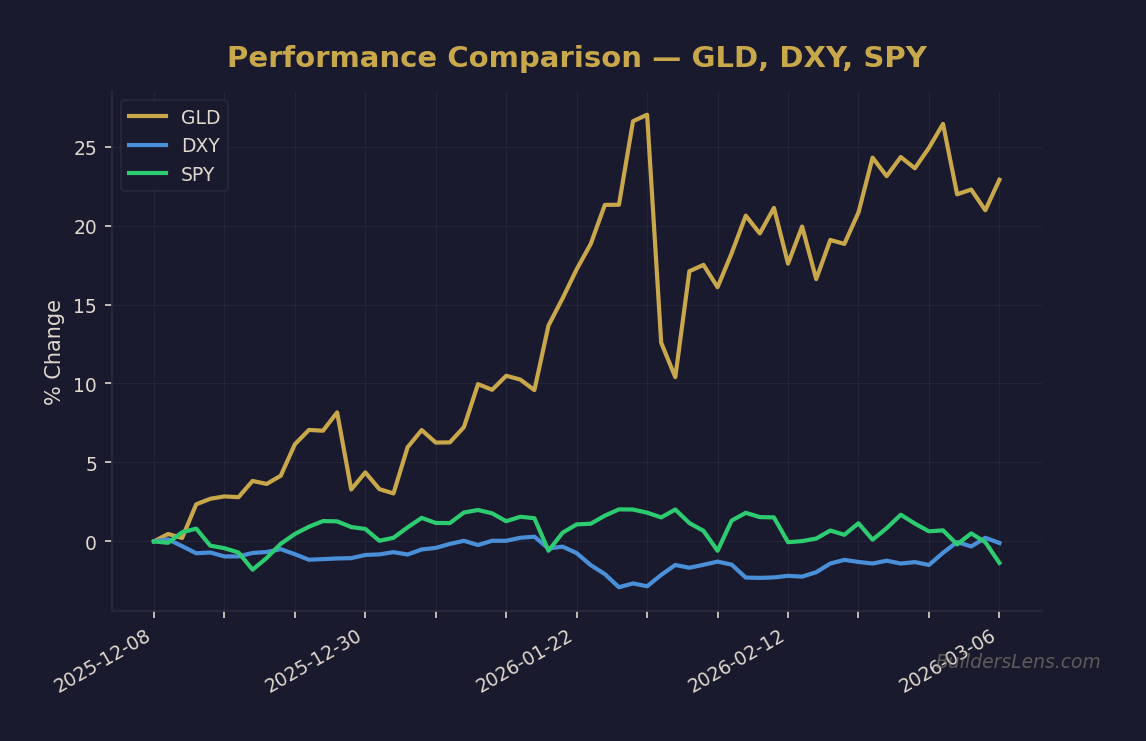
Source: BuildersLens.com Signal Framework | Data as of March 08, 2026
In that environment, gold’s role is not “fear.” It is a non-liability asset that does not depend on someone else’s future cash flows. It can reprice when the market senses that the unit is being diluted, even if economic data look stable and equities are still strong.
Mechanism Two: Reserve Trust Stress
When reserves can be frozen or impaired, the global reserve system inherits a credibility problem. Reserve managers respond by reallocating marginal reserves toward assets that are no one else’s liability. That shift can create a structural bid for gold that is less sensitive to retail positioning and more anchored in policy behavior.
Mechanism Three: The Participation Gap
Large moves can occur without broad ownership if flows are dominated by official sector demand and institutional hedging. If broader allocation increases later, volatility often increases alongside it. This is why positioning and liquidity conditions must be monitored alongside macro narratives.
Phase Mapping and Probability Sequencing
We map current conditions as late Phase One instability pricing. Structural pressures are visible, but forced liquidity stress has not yet dominated.
Confirmations to Monitor
- Stable or declining real yields
- Persistent central bank accumulation
- Contained dollar funding pressure
Invalidations to Monitor
- Sustained rise in real yields
- Credit spread widening and tightening liquidity
- Evidence of forced deleveraging
Disciplined Close
The durable edge is not forecasting a specific price target. It is understanding which mechanism is dominant in which phase. When the plumbing changes, price follows. Our Strategy focuses on signals over narratives and probabilities over conviction.
Get the Daily Phase Brief
Signal changes, data releases to watch, and today’s regime assessment — delivered every morning before market open.
Join investors tracking the macro cycle. Unsubscribe anytime.
📊 Run Your Own Analysis
Use the BuildersLens 65-Signal Analyzer to see live macro positioning for tickers mentioned in this article:
This article is for educational and informational purposes only and does not constitute investment advice. Past performance is not indicative of future results. Consult with a qualified financial advisor before making investment decisions.