Research · Cycle Sequencing & Phases
Is Post-Inflation Deflation the Real 2026 Trade? Signals Behind Stocks, Bitcoin and Bonds

Post-Inflation Deflation or Late-Cycle Delay?
The core macro debate entering 2026 is not whether markets are strong. It is whether strength reflects durable expansion or late-cycle compression that has not yet surfaced in index-level pricing.
In this analysis, we translate a recent macro discussion into Our Strategy’s probability-based, phase-sequenced framework. We emphasize mechanisms over narratives, confirmation over prediction, and sequencing over timing.
Framework Positioning: Late Phase 1 With Rising Phase 2 Pressure
Current conditions most closely resemble late Phase 1 behavior: elevated valuations, subdued volatility, narrowing participation, and growing cross-asset divergence.
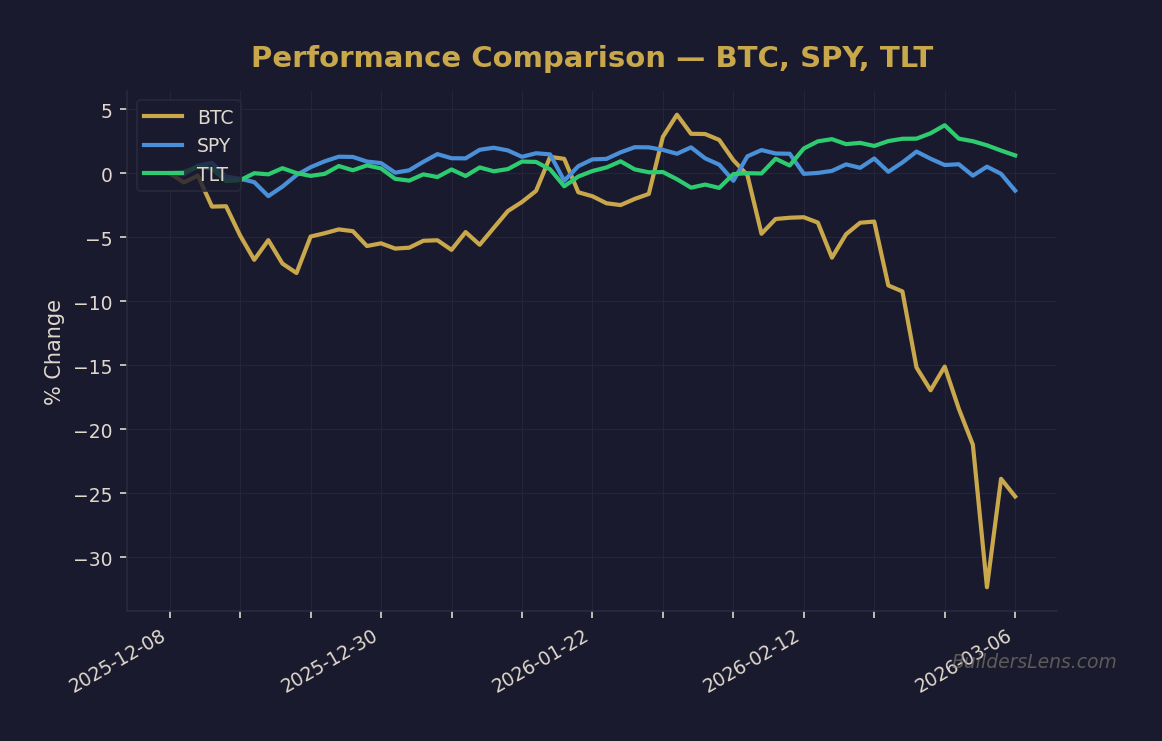
Source: BuildersLens.com Signal Framework | Data as of March 08, 2026
Phase 2 probability rises when volatility begins to structurally expand, credit spreads widen persistently, and leadership concentration increases rather than broadens.
Mechanism: How Post-Inflation Deflation Develops
The transmission sequence matters more than any individual price target.
- Speculative assets weaken first as leverage sensitivity increases.
- Volatility mean reverts higher from compressed levels.
- Financial conditions tighten via higher risk premiums.
- Credit spreads begin to widen.
- Growth expectations compress.
- Inflation expectations follow.
- Duration stabilizes and may outperform.
This is the classical late-cycle compression pathway. It does not require panic. It requires confirmation.
What Has Changed
- Speculative leadership has shown signs of rollover.
- Growth-sensitive commodities have stopped accelerating.
- Inflation readings struggle to re-accelerate sustainably.
What Has Not Changed
- Credit markets remain orderly.
- Volatility remains historically compressed.
- Liquidity has not shown systemic disruption.
Without credit confirmation, Phase 3 remains a lower-probability tail scenario rather than a base case.
Probability Calibration
Through June 2026
- Phase 1 continuation: 40–55%
- Phase 2 compression: 35–45%
- Phase 3 stress acceleration: 10–20%
Through December 2026
- Phase 2 dominant: 40–55%
- Phase 1 re-acceleration: 20–30%
- Phase 3 escalation: 20–30%
Through June 2027
- Extended compression cycle: 35–50%
- Policy-delay melt-up extension: 20–35%
- Full Phase 4 liquidity reset window: 15–25%
Signals to Monitor
- Equity volatility regime shift
- High-yield and investment-grade spread direction
- Long-duration yield behavior
- Market breadth deterioration
- Cross-asset correlation tightening
Invalidation Conditions
- Sustained breadth expansion across sectors
- Volatility remaining structurally suppressed
- Credit spreads staying tight despite equity softness
- Re-acceleration in inflation expectations alongside stable growth
Until those invalidations occur, late-cycle compression risk remains active, but not confirmed.
Final Perspective
We do not need to predict the year deflation appears. We need to identify whether the system transitions from policy-delay stability to cyclical reset pressure.
Optionality remains more valuable than conviction in late-cycle environments. Confirmation remains more important than narrative alignment.
Get the Daily Phase Brief
Signal changes, data releases to watch, and today’s regime assessment — delivered every morning before market open.
Join investors tracking the macro cycle. Unsubscribe anytime.
📊 Run Your Own Analysis
Use the BuildersLens 65-Signal Analyzer to see live macro positioning for tickers mentioned in this article:
This article is for educational and informational purposes only and does not constitute investment advice. Past performance is not indicative of future results. Consult with a qualified financial advisor before making investment decisions.