Research · Uncategorized
Minsky Financial Instability Hypothesis
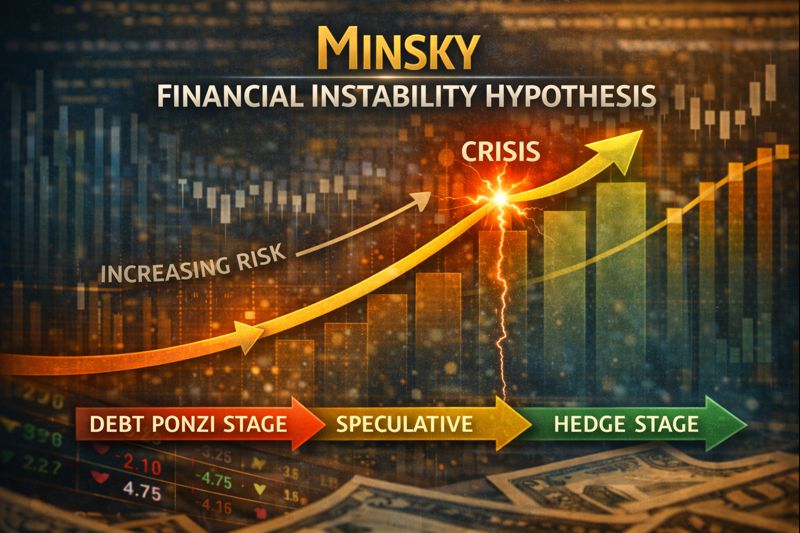
Minsky’s Financial Instability Hypothesis
Why Stability Itself Eventually Creates Instability
Hyman Minsky’s Financial Instability Hypothesis explains one of the most
counterintuitive truths in finance:
The longer a system remains stable, the more fragile it becomes.
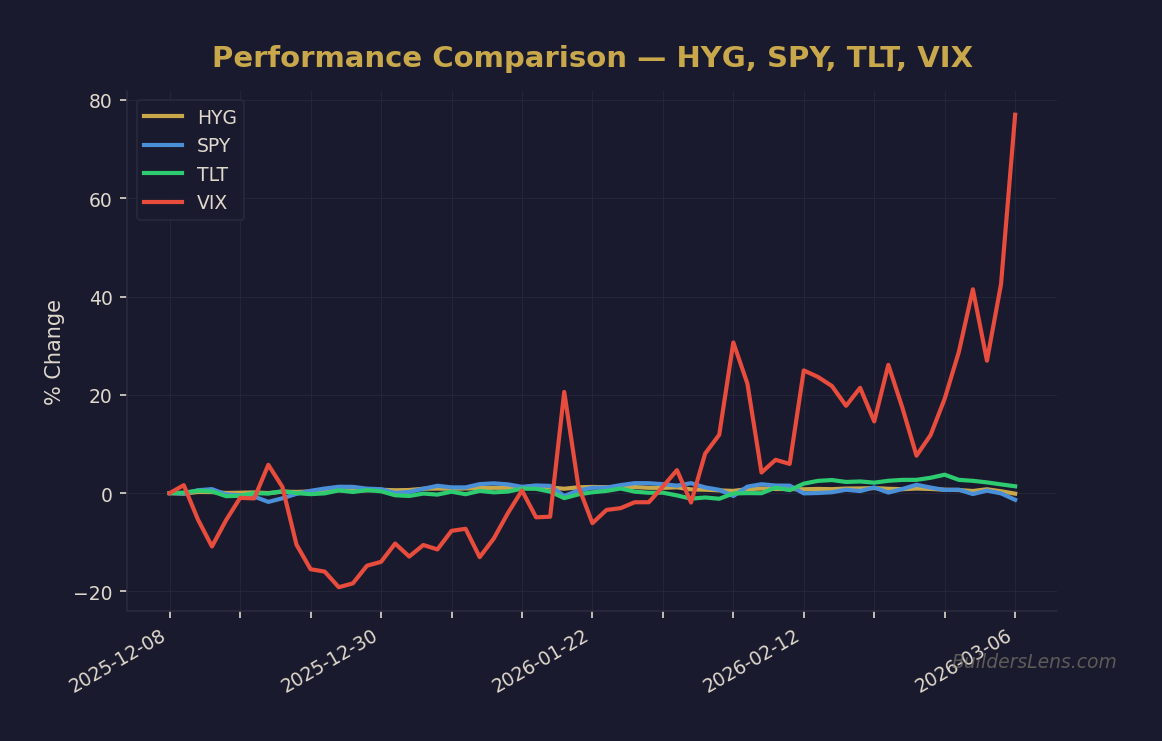
Source: BuildersLens.com Signal Framework | Data as of March 08, 2026
This idea runs directly against common intuition.
Most people assume stability reduces risk.
Minsky argued the opposite — and history has repeatedly proven him right.
What Is the Financial Instability Hypothesis? (Plain English)
Minsky’s core insight was behavioral, not mathematical.
When economic conditions are stable for long periods:
- People become more confident
- Risk feels lower than it actually is
- Borrowing increases
Over time, this changes how people finance themselves.
Stability alters behavior —
and altered behavior changes the structure of the system.
The Three Types of Financing (Minsky’s Core Framework)
Minsky described three stages of financing that appear
as cycles mature.
1. Hedge Finance
- Borrowers can repay both principal and interest
- Cash flows comfortably cover obligations
- Risk is manageable
2. Speculative Finance
- Borrowers can cover interest
- Principal must be rolled over
- Refinancing becomes essential
3. Ponzi Finance
- Borrowers rely on rising asset prices
- Cash flows no longer cover obligations
- Stability depends on continued optimism
The system becomes fragile not all at once —
but gradually, as financing quality deteriorates.
Why Minsky Matters in Modern Markets
Minsky explains why crises feel sudden,
even though the conditions that caused them
built slowly over time.
As stability persists:
- Leverage rises
- Risk controls loosen
- Refinancing assumptions harden
The system appears stable —
until something interrupts refinancing.
At that point, fragility is revealed.
Where Minsky Fits in the Five Phases
Phase 0 — Post-Crisis Expansion
In Phase 0:
- Financing is conservative
- Risk aversion remains high
- Hedge finance dominates
Memories of crisis are still fresh.
Phase 1 — Melt-Up / Liquidity Illusion
Phase 1 is where Minsky’s insight becomes powerful.
In this phase:
- Stability feels permanent
- Speculative finance expands
- Leverage increases quietly
Volatility is low.
Confidence is high.
This is where instability is born —
disguised as safety.
Phase 2 — Crack Formation / Rolling Stress
In Phase 2:
- Refinancing becomes selective
- Ponzi finance is exposed
- “Isolated problems” begin to appear
The system does not collapse yet.
But confidence becomes fragile.
Phase 3 — Forced Liquidation
Phase 3 is Minsky’s moment.
In this phase:
- Refinancing fails
- Assets are sold to meet obligations
- Correlations move toward one
What appeared stable reveals itself
as deeply unstable.
The crisis is not caused by panic —
panic is caused by the structure that stability created.
Phase 4 — Reset / Accumulation
In Phase 4:
- Leverage is reduced
- Risk aversion returns
- Financing quality improves
The system becomes safer —
but only after instability has cleared.
Where We Are Today
The current environment shows many characteristics
Minsky warned about.
These include:
- Extended periods of low volatility
- High reliance on refinancing
- Confidence in perpetual liquidity support
In Five Phases terms:
These conditions align most closely with late Phase 1
transitioning into Phase 2 —
where stability has already bred fragility.
The key risk is not sentiment.
It is the structure of financing.
What Minsky Can — and Cannot — Tell Us
Minsky’s framework helps answer:
Has stability changed behavior in ways that increase fragility?
It cannot:
- Time market crashes
- Predict catalysts
- Replace credit spread analysis
It explains vulnerability —
not timing.
Final Takeaway
Minsky’s Financial Instability Hypothesis explains
why the most dangerous moments
often emerge from periods of calm.
- Stability changes behavior
- Behavior increases leverage
- Leverage creates fragility
Within the Five Phases framework,
Minsky explains why
Phase 1 leads inevitably toward Phase 3 —
even when everything appears fine.
Stability is not safety.
Get the Daily Phase Brief
Signal changes, data releases to watch, and today’s regime assessment — delivered every morning before market open.
Join investors tracking the macro cycle. Unsubscribe anytime.
📊 Run Your Own Analysis
Use the BuildersLens 65-Signal Analyzer for live macro positioning:
→ Analyze HYG (High Yield Credit)
This article is for educational and informational purposes only and does not constitute investment advice. Past performance is not indicative of future results. Consult with a qualified financial advisor before making investment decisions.