Research · Credit & Liquidity
Most people watch “stress” and assume it automatically means “crash.” In credit, that’s not how it works.

Hook
Most people watch “stress” and assume it automatically means “crash.” In credit, that’s not how it works.
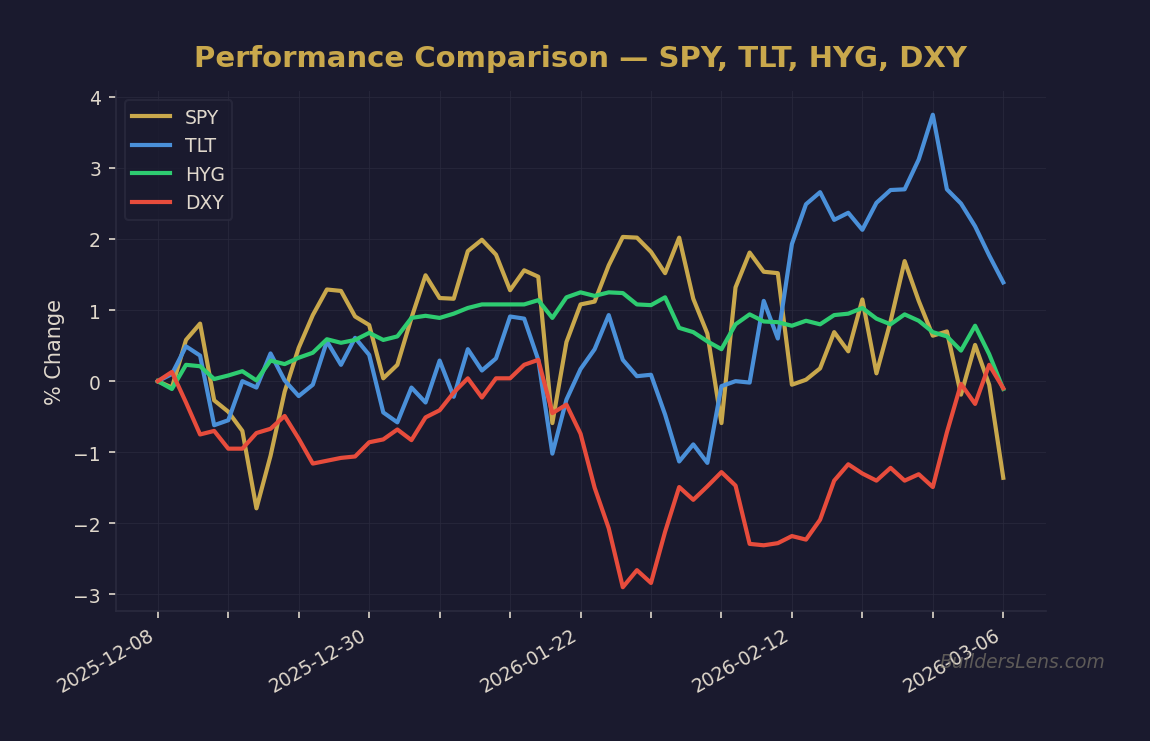
Source: BuildersLens.com Signal Framework | Data as of March 08, 2026
The real hinge is simpler: when funding backstops weaken, stress turns into forced selling — and the cycle speeds up.
Disclaimer
This post is for educational macro commentary only and is not financial advice. It reflects a probability-weighted macro framework and does not recommend specific trades.
Our Strategy Lens
Our Strategy focuses on sequencing — what breaks first, what transmits next, and what confirms a phase transition.
This episode translates Eurodollar University’s “three stages of a credit downturn” into a rules-based approach: don’t predict the crisis; monitor the confirmation gate that turns “pressure” into “cascade.”
Signals That Matter
1) Stage 1: Withdrawals (Stress Builds Quietly)
- Investors notice risk and pull cash or reduce exposure
- Prices may remain stable because banks / large balance sheets temporarily fill the gap
- Markets can look “fine” while fragility increases underneath
In Our Strategy terms: this is often late Phase 1 behavior — stability on the surface, cracks in the plumbing.
2) Stage 2: Forced Selling (The Hinge)
- The key transition begins when backstops weaken (banks pull back, dealer balance sheets shrink, funding tightens)
- If cash is demanded but funding is not available, the system must sell assets quickly
- This is where a downturn becomes mechanical: tight funding → asset sales → lower prices → more pressure
Our Strategy treats this as the critical gate: Stage 2 is where “stress” becomes “forced.”
3) Stage 3: Systemic Spread (Correlation Takes Over)
- Pressure spreads beyond the initial pocket of weakness
- Correlations rise and diversification fails
- Policy response becomes reactive, not preventative
This is where optionality matters most — because the window to “decide calmly” compresses.
The Confirmation Signal That Matters Most
- Banks / backstops still stepping in → Stage 1 can persist longer than expected
- Banks pulling back → Stage 2 risk rises sharply
- Funding tightness + forced liquidations → Stage 3 becomes plausible
Translation: watch bank behavior and funding conditions, not just “bad news.”
Phase Mapping (Our Strategy Framework)
| Phase | Definition | Status | Key Signal |
|---|---|---|---|
| Phase 1 | Hidden Fragility | Active | Withdrawals rising, but backstops still present (Stage 1 conditions) |
| Phase 2 | Asymmetric Sensitivity | Probability rising | Backstops weakening; funding stress increasing (Stage 2 gate forming) |
| Phase 3 | Forced Repricing | Not confirmed | Forced selling + broader spread + correlation jump (Stage 2 → Stage 3) |
Sensitive Instruments to Monitor (Not Trade Calls)
- Credit spreads (HY / IG) — the first visible “math” of risk repricing
- Funding stress gauges — where Stage 2 begins (availability of cash)
- Bank and dealer proxies — capacity and willingness to backstop markets
- Broad equities (SPY) + concentration — fragility once correlation rises
- Long duration (TLT / ZROZ) — regime sensitivity as liquidity shifts
What Changed
- Process focus shifts toward the Stage 1 → Stage 2 hinge
- Reassessment cadence increases as funding signals matter more
- Confirmation gates tighten: “stress” alone is not enough — backstop behavior is the tell
What Didn’t Change
- No predictions, no “crash calls” from early stress
- No all-in moves — tranche discipline remains non-negotiable
- Sequencing over narratives: funding mechanics > headlines
Process Adjustments (Not Trade Recommendations)
- Upgrade funding + bank behavior to top-tier confirmation signals
- Reduce reaction time assumptions — Stage 2 compresses timelines
- Preserve optionality (cash / flexibility) until forced-selling risk is resolved
- Wait for confirmation before treating stress as a phase transition
Original Source & Credit
This episode reviews and translates the following original video for educational purposes:
Original video — Eurodollar University: How Financial Crises Actually Start
Close
The market can tolerate “stress” longer than most expect — as long as backstops remain willing and able.
But when that support weakens, the cycle shifts from narrative to mechanics — and forced selling becomes the story.
Background is generated via Prompt 2.
Get the Daily Phase Brief
Signal changes, data releases to watch, and today’s regime assessment — delivered every morning before market open.
Join investors tracking the macro cycle. Unsubscribe anytime.
📊 Run Your Own Analysis
Use the BuildersLens 65-Signal Analyzer for live macro positioning:
→ Analyze HYG (High Yield Credit)
→ Analyze DXY (US Dollar Index)
This article is for educational and informational purposes only and does not constitute investment advice. Past performance is not indicative of future results. Consult with a qualified financial advisor before making investment decisions.