Research · Credit & Liquidity
Private Credit Stress Is Spreading Beyond “Cockroaches”
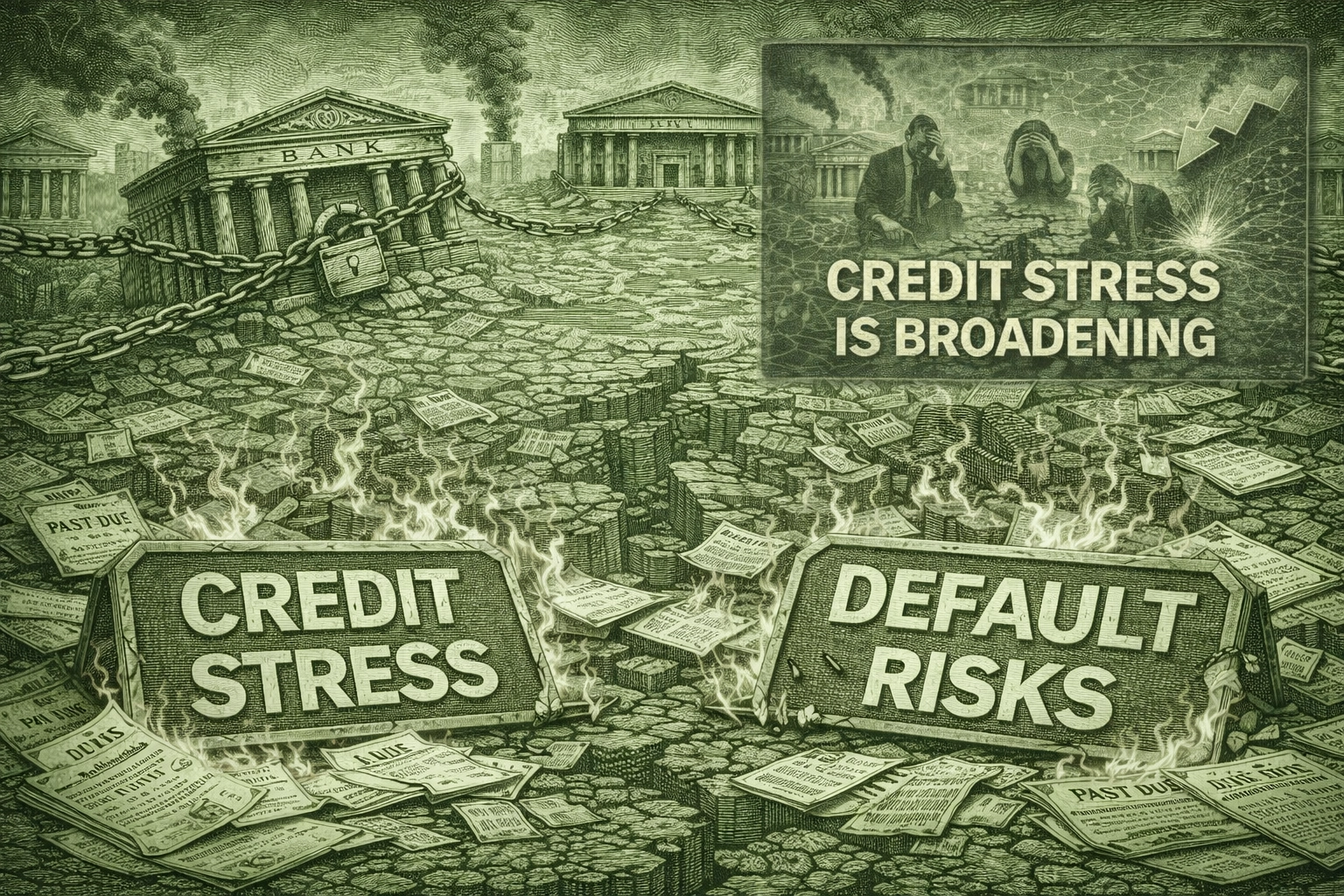
Private Credit Stress Is Spreading Beyond Early Weak Spots
In Our Strategy, we prioritize sequencing over prediction.
Credit cycles rarely fail all at once. They deteriorate unevenly, with stress
first appearing in weaker structures before testing the system more broadly.
The key question is not whether isolated problems exist. It is whether stress
is moving from valuation debate into liquidity necessity.
What the Source Video Is Actually Claiming
The source video argues that private credit stress is no longer confined to
isolated borrowers or niche structures. What began as early warning signs has
broadened across sectors and vehicles.
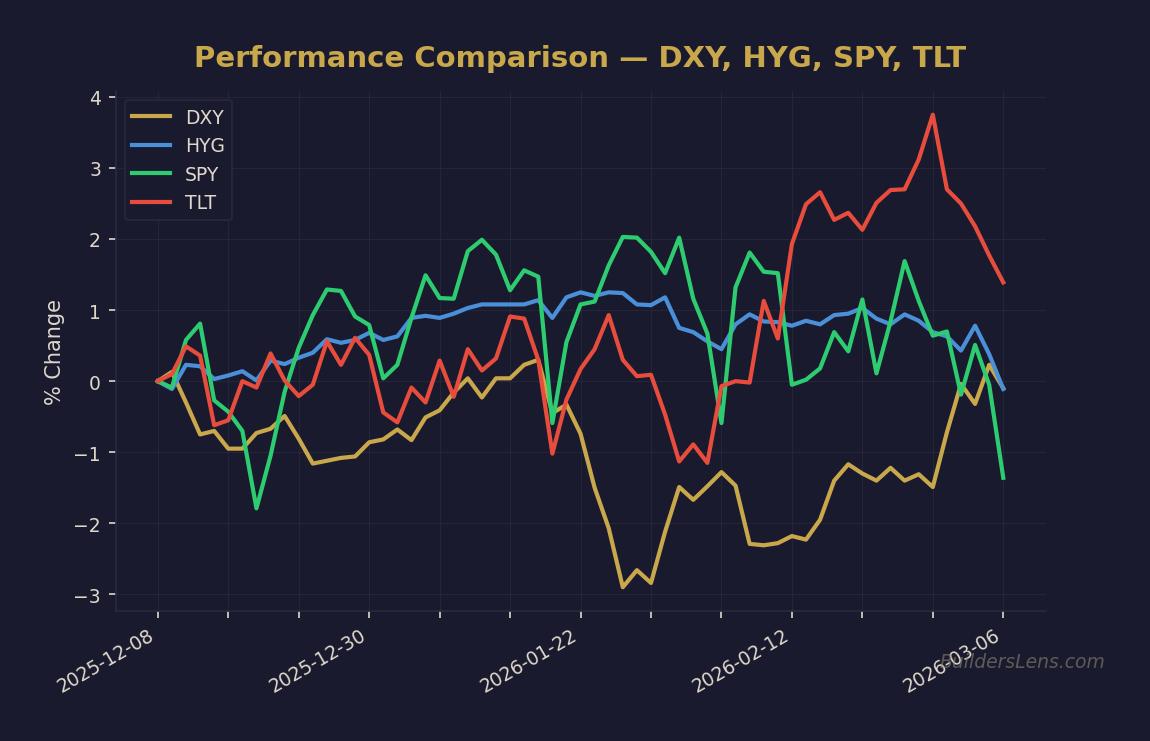
Source: BuildersLens.com Signal Framework | Data as of March 08, 2026
- Multiple private credit managers and BDCs repricing simultaneously
- Leveraged loan behavior deteriorating alongside private credit proxies
- Large capital expenditure funding needs acting as stress tests for credit availability
The claim is not that a collapse is underway, but that the margin for error in
private credit financing is narrowing.
Signal Classification Within Our Strategy
- Credit: Private credit marks, leveraged loan pricing, and recovery assumptions
- Liquidity: Redemption pressure, refinancing gaps, and funding access
- Rates & yields: Long-end behavior as a constraint on refinancing math
- Market structure: Public proxies as early sentiment and liquidity indicators
This is a Phase 1 credit deterioration signal with rising Phase 2 pressure,
not yet a forced-liquidity confirmation.
The Mechanism: How Credit Stress Becomes Systemic
Early in a credit downturn, stress shows up as mark-to-model debate.
Valuations can be defended as long as liquidity remains available.
The transition occurs when:
- Redemptions or funding needs force asset sales
- Refinancing becomes unavailable or prohibitively expensive
- Recovery assumptions are revised lower across portfolios
At that point, stress shifts from perception to mechanics. Liquidity, not
narrative, determines outcomes.
Phase Mapping: Where This Fits in the Cycle
Within Our Strategy framework, this signal set aligns with
late Phase 1: Fragility Beneath Stable Index Levels.
Phase 2 behavior requires visible forced-liquidity dynamics—redemptions,
emergency financing, or disorderly repricing—not just broader awareness
of risk.
Probability & Timeline Assessment (Non-Predictive)
-
Phase 1 continuation with elevated credit fragility:
~55–65% probability through mid-2026 if funding remains accessible. -
Transition toward Phase 2 conditions:
~25–35% probability by December 2026 if redemption pressure or refinancing
stress persists. -
Phase 3 policy-dominant regime:
~15–25% probability by June 2027, conditional on tightening financial
conditions and forced selling.
Credit stress raises risk density, but liquidity determines timing.
What Changes in Our Strategy
- Greater weight on credit-proxy confirmation across public and private markets
- Higher sensitivity to redemption pressure and emergency funding needs
- Increased emphasis on funding sources rather than borrower narratives
What Does Not Change
- No assumption of Phase 2 behavior without forced-liquidity evidence
- No extrapolation from single stocks or isolated headlines
- No abandonment of probability-based sequencing
- No erosion of optionality while liquidity remains available
Signals We Continue to Monitor
- High-yield and leveraged loan spread behavior
- BDC and private credit manager relative performance
- Redemption terms, emergency financing, and restructuring headlines
- Long-end yield behavior and refinancing math
- Dollar strength as a global liquidity constraint
Invalidation Conditions
- Stabilization in private credit marks alongside renewed issuance
- Compression in leveraged loan and high-yield spreads
- Broad improvement in funding conditions without policy distortion
Source
This article is for educational and informational purposes only. It reflects a
probability-based analytical framework and does not constitute investment advice
or recommendations.
Get the Daily Phase Brief
Signal changes, data releases to watch, and today’s regime assessment — delivered every morning before market open.
Join investors tracking the macro cycle. Unsubscribe anytime.
📊 Run Your Own Analysis
Use the BuildersLens 65-Signal Analyzer for live macro positioning:
→ Analyze HYG (High Yield Credit)
→ Analyze DXY (US Dollar Index)