Research · Macro Regime
Real Estate Works Until Liquidity Shifts

Real Estate Is a Funding-Cycle Asset
Most real estate discussions focus on property selection, rent growth, and management execution. Those variables matter. But within Our Strategy framework, the dominant driver of valuation over time is not the kitchen renovation or lease strategy. It is the funding regime.
Real estate is a duration-sensitive asset. Net operating income is multiplied by the market’s required yield. When liquidity expands and credit is easily available, cap rates compress and operational improvements translate into valuation expansion. When term premium rises and long-duration yields reprice higher, that same income stream is discounted more aggressively. That is where compression risk emerges.
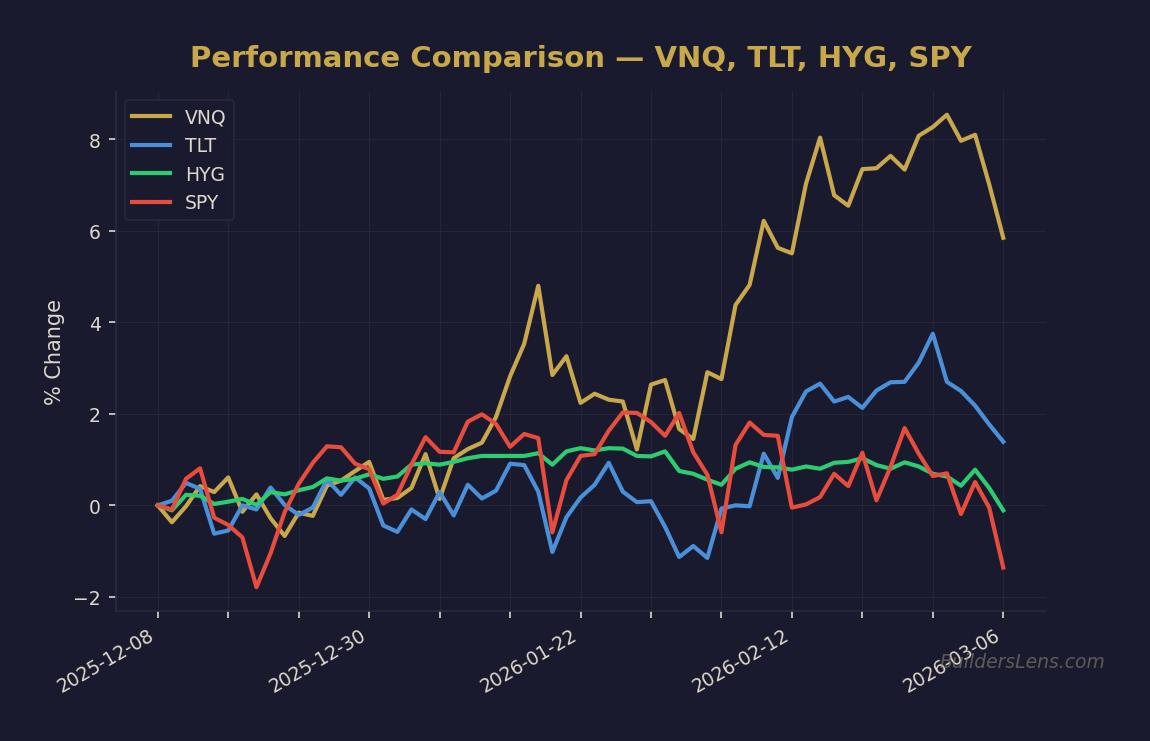
Source: BuildersLens.com Signal Framework | Data as of March 08, 2026
Phase Mapping Within Our Strategy Framework
Within Our Strategy’s five-phase model, current conditions most closely resemble late Phase 1 (Melt-Up Participation) transitioning toward early Phase 2 (Multiple Compression).
- Liquidity: No longer accelerating cleanly.
- Labor: Softening beneath headline strength.
- Credit: Spreads contained, but private credit stress emerging.
- Long Yields: Sensitive to fiscal issuance and auction dynamics.
This configuration increases valuation sensitivity even if rents remain stable.
Probability Timeline
Base Case: Approximately sixty percent probability that Phase 2 pressure builds into mid twenty twenty six. This implies increasing valuation compression risk without immediate systemic breakdown.
Downside Case: Roughly thirty percent probability of Phase 3 (Credit Stress) into late twenty twenty six if spreads widen and funding tightens.
Extended Melt-Up Case: Around ten percent probability of continued benign expansion into early twenty twenty seven, contingent on re-acceleration in liquidity and sustained labor strength.
The Rollover Trap Risk
The critical mechanism to monitor is what we refer to as the rollover trap. Policy rates may decline, but if long-duration yields remain elevated due to term premium expansion, refinancing costs do not materially improve. That dynamic compresses transaction volume, freezes development pipelines, and pressures levered balance sheets.
This is how valuation resets can occur without a dramatic housing crash headline.
What Changes vs. What Does Not
What Changes
- Refinancing sensitivity increases.
- Cap rate expansion risk rises.
- Transaction volumes compress.
What Does Not Change
- Operational discipline still matters.
- Cash flow remains foundational.
- Liquidity sequencing ultimately determines valuation regime.
Monitoring Dashboard
We are monitoring:
- Long-duration Treasury yields
- Credit spreads (investment grade and high yield)
- Bank lending standards
- Hiring rate and labor participation
- Funding market stability
Confirmation of compression risk would include sustained credit widening, deterioration in hiring rates, and long yields remaining elevated despite softer growth data.
Invalidation would require broad credit stabilization, liquidity re-acceleration, and durable labor improvement.
Conclusion: Real Estate Is Sequencing
Real estate investing is not simply a property decision. It is a timing decision within a funding cycle. Investors who respect liquidity sequencing preserve optionality and deploy capital when asymmetry improves.
Our Strategy focuses on mechanism, phase pressure, and confirmation thresholds — not narrative optimism or crash predictions.
Get the Daily Phase Brief
Signal changes, data releases to watch, and today’s regime assessment — delivered every morning before market open.
Join investors tracking the macro cycle. Unsubscribe anytime.
📊 Run Your Own Analysis
Use the BuildersLens 65-Signal Analyzer for live macro positioning:
→ Analyze HYG (High Yield Credit)
This article is for educational and informational purposes only and does not constitute investment advice. Past performance is not indicative of future results. Consult with a qualified financial advisor before making investment decisions.