Research · Credit & Liquidity
Settlement Risk and Liquidity Phases: Where Stress Starts Before Price

Markets Feel Instant. Settlement Is Not.
Markets look fast. Trades execute in milliseconds. Portfolios update in real time. But beneath that surface speed, money and collateral still move through delayed settlement systems, layered intermediaries, and reconciliation processes that were built for a slower era.
Our Strategy does not begin with narratives. We begin with mechanisms. And the mechanism here is simple: liquidity stress typically appears in the plumbing layer before it shows up in price.
The system can look stable while becoming structurally tight underneath.
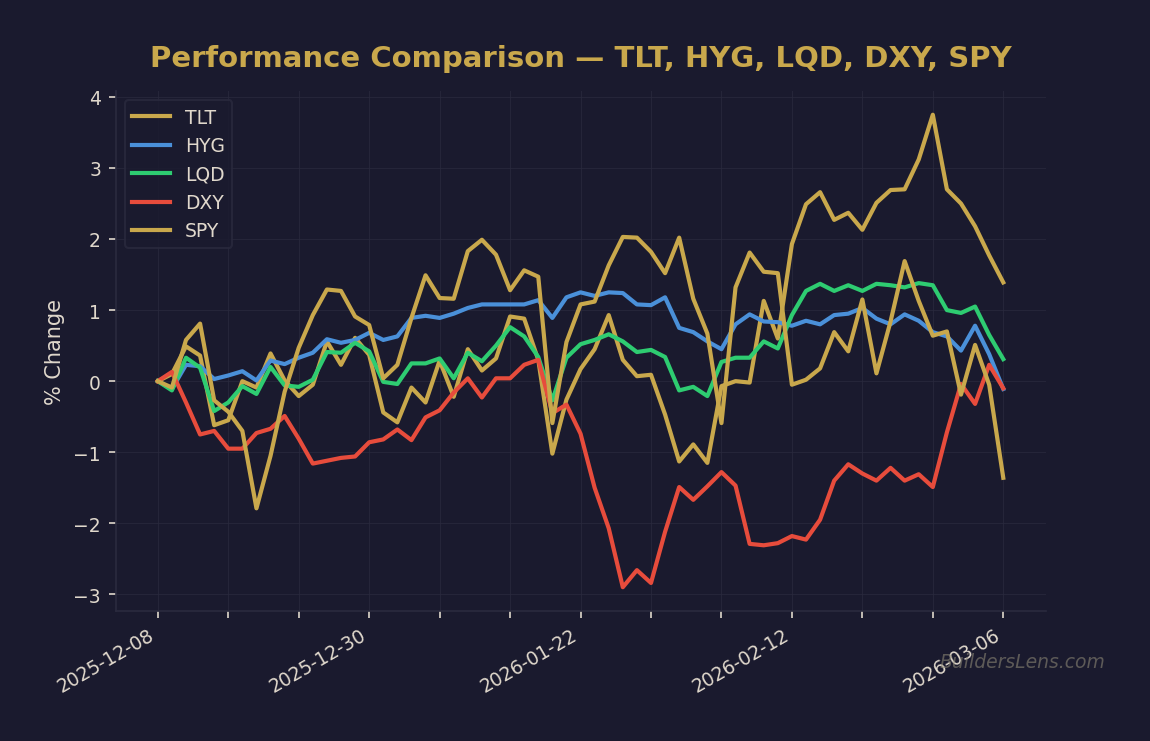
Source: BuildersLens.com Signal Framework | Data as of March 08, 2026
The Plumbing Layer: Where Stress Actually Starts
When liquidity tightens, the first fractures rarely appear in earnings headlines or economic commentary. They show up in:
- Funding markets: rising margin sensitivity, collateral scarcity, tighter repo conditions.
- Credit spreads: incremental widening that signals refinancing risk repricing.
- Settlement friction: operational delays and reconciliation burdens that amplify volatility.
Delayed settlement forces institutions to operate with buffers, intermediaries, and duplicated record-keeping systems. In calm regimes, this is manageable. In tightening regimes, those frictions become nonlinear.
This is why we monitor credit and funding before we interpret equity volatility. Price is the outcome. Plumbing is the cause.
Where Blockchain Fits — Without Hype
The institutional conversation around blockchain is often misunderstood. It is not about replacing financial cycles. It is about reducing operational friction in specific workflows.
Selective improvements include:
- Shorter settlement windows.
- Shared ledger visibility that reduces reconciliation steps.
- Programmable servicing and reporting.
- Stablecoin rails that function as near-cash equivalents in certain contexts.
However, faster rails do not eliminate liquidity regimes. They may reduce friction, but they can also accelerate transmission. Optionality can expand — or concentration risk can increase. The phase still matters.
Our Five Phase Framework: Mapping the Current Regime
We sequence markets through five structural phases. The current environment reflects Late Phase One with rising Phase Two pressure.
Current Phase — Late Phase One
Surface stability with internal rotation. Leadership narrows. Defensive assets quietly outperform. Correlation risk begins rising beneath the surface.
Next Phase — Phase Two (Conditional)
Multiple compression and deeper rotation if liquidity momentum remains flat and leadership instability persists.
Tail Phase — Phase Three (Credit Transmission)
Requires confirmed spread widening, refinancing strain, and sustained funding stress.
Date-Anchored Probabilities
- Late Phase One continuation into mid 2026: approximately sixty percent.
- Phase Two transition into late 2026: approximately thirty percent.
- Phase Three credit transmission into mid 2027: approximately twenty percent.
These are conditional pathways, not predictions. We update probabilities as signals confirm or invalidate.
Stablecoins: Underestimated Adoption Curve
One structural shift that markets may be underestimating is the institutional adoption of stablecoins as collateral and operational settlement tools.
Regulatory clarity around qualifying stablecoins has materially altered capital treatment for certain institutional participants. This reduces operational friction and opens new use cases in:
- Collateral mobility.
- Variation margin settlement.
- Tokenized fund subscriptions and redemptions.
- Cross-border settlement efficiency.
The mechanism is not speculative enthusiasm. It is cost reduction and balance sheet efficiency.
Confirmation vs Invalidation: What We Watch
Confirmation of Rising Phase Pressure
- Sustained credit spread widening.
- Persistent funding strain signals.
- Weaker Treasury auction demand.
- Repeated failed equity rebounds with rising cross-asset correlation.
Invalidation Signals
- Improving market breadth.
- Stable or compressing credit spreads.
- Orderly funding conditions.
We do not react to isolated prints. We wait for sequencing and confirmation.
Monitoring Proxies (Observation Only)
- Rates and duration: IEF, TLT
- Credit spreads: HYG, LQD
- Dollar and funding impulse: UUP
- Equity breadth: SPY, QQQ
- Crypto beta context: Bitcoin proxy vehicles
These are structural observation handles, not trade triggers.
Durable Takeaway
Markets do not fracture because narratives change. They fracture when constraints tighten.
Settlement friction, collateral mobility, and funding access determine how resilient a regime truly is. Blockchain infrastructure may reduce specific operational bottlenecks. It will not remove liquidity cycles.
Our Strategy remains probability-based, confirmation-driven, and phase-sequenced. We manage optionality. We respect transmission risk. And we let the plumbing tell us when the next phase activates.
Educational only. This content reflects a probability-based analytical framework and is not investment advice.
Research hub: BuildersLens.com
Sponsor: v6d.com
Get the Daily Phase Brief
Signal changes, data releases to watch, and today’s regime assessment — delivered every morning before market open.
Join investors tracking the macro cycle. Unsubscribe anytime.
📊 Run Your Own Analysis
Use the BuildersLens 65-Signal Analyzer to see live macro positioning for tickers mentioned in this article:
→ Analyze TLT (Long-Term Treasuries)
This article is for educational and informational purposes only and does not constitute investment advice. Past performance is not indicative of future results. Consult with a qualified financial advisor before making investment decisions.