Research · Credit & Liquidity
The Silver Crash Explained Through Market Structure

From Metals Volatility to Credit Stress: A Structural Breakdown
Gold declined sharply. Silver fell even harder. A major private credit vehicle marked down close to one fifth of its value in a single quarter.
These are not isolated events.
Our Strategy approaches this through mechanisms over narratives. We are not asking who caused the move. We are asking what structural pressure forced the move.
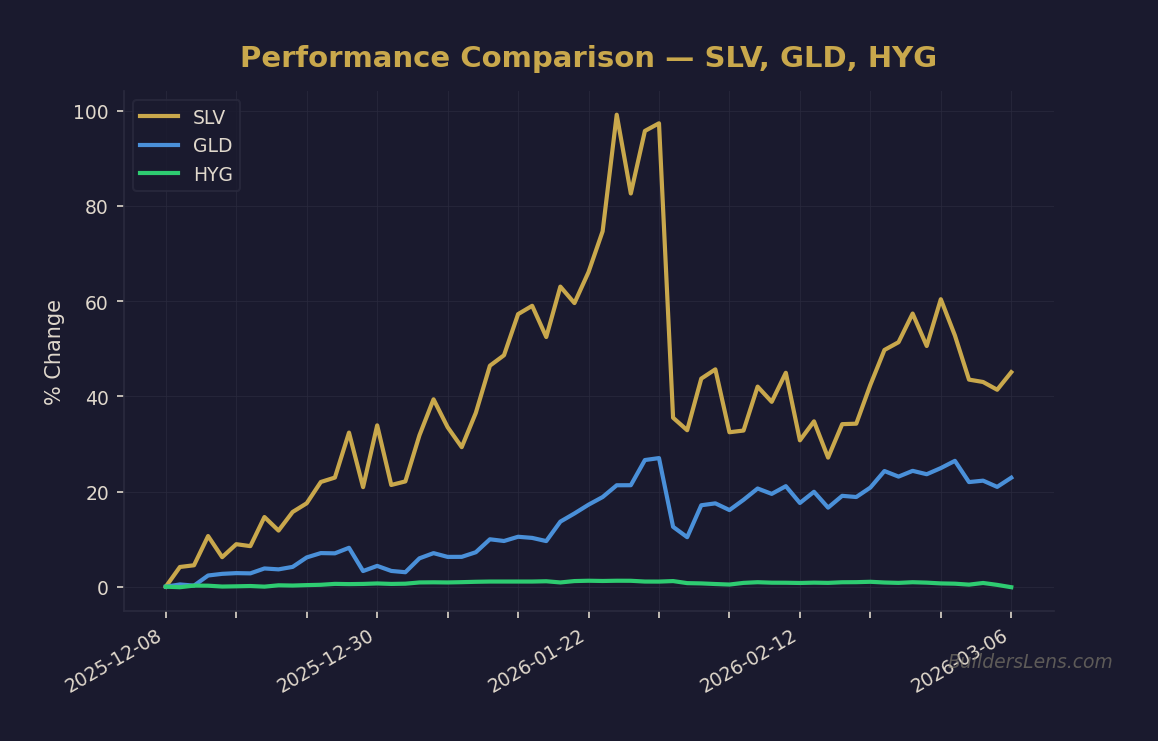
Source: BuildersLens.com Signal Framework | Data as of March 08, 2026
Step One: The Metals Drop Was Mechanical
Margin Before Macro
When exchanges raise margin requirements, leveraged participants must post additional collateral or reduce exposure. In highly levered positioning environments, small margin adjustments create nonlinear selling pressure.
If leverage is twenty to one, a minor margin adjustment forces capital calls that can represent multiples of the underlying percentage change. When enough participants face the same constraint simultaneously, price becomes a function of liquidity mechanics rather than conviction.
This explains how metals can fall aggressively even when long-term structural narratives remain intact.
Step Two: Private Credit Is Not “Off-System”
Private credit has grown into a significant and opaque segment of the financial system. While loans are originated outside traditional banks, the ecosystem remains deeply interconnected through:
- Bank credit facilities
- Hedging structures and derivatives
- Liquidity promises to investors
- Valuation models that smooth mark-to-market stress
When markdowns appear in large vehicles, the immediate question is not insolvency. The question is transmission.
Do redemption pressures rise? Do funding costs increase? Do banks tighten exposure indirectly?
This is how Phase Two pressure transitions toward Phase Three credit stress.
Confiscation Risk: Reframed Through Modern Mechanisms
The popular narrative focuses on physical seizure. Our Strategy assigns low probability to that path.
Modern systems do not require door-to-door enforcement. They operate through administrative channels:
- Tax framing and windfall structures
- Reporting thresholds and compliance burdens
- Transaction friction at points of convertibility
- Liquidity constraints embedded within payment rails
The relevant question is not whether you “own” an asset. The relevant question is how easily that asset converts into usable liquidity under evolving rules.
Our Phase Sequencing Framework (Date Anchored)
Current Regime: Phase Two Pressure
Probability: Approximately sixty percent through mid twenty twenty six.
Characteristics include multiple compression, selective liquidity, isolated credit stress, and volatility clustering.
Conditional Transition: Phase Three Credit Stress
Probability: Approximately twenty five percent by mid twenty twenty six.
Requires confirmation through widening credit spreads, funding friction, and redemption management behavior expanding beyond isolated vehicles.
Tail Scenario: Phase Four Liquidity Event
Probability: Approximately fifteen percent by late twenty twenty six.
This scenario would involve visible dysfunction in funding markets and disorderly asset repricing that forces policy response.
Confirmations vs Invalidations
Confirmations of Escalating Stress
- Persistent widening in high yield credit spreads
- Regional bank stress re-emerging
- Private credit vehicles restricting redemptions broadly
- Funding markets showing sustained tightening
Invalidations of Immediate Systemic Risk
- Credit spreads stabilize and tighten
- Redemption restrictions remain isolated
- Funding markets remain orderly
- Metals volatility subsides without renewed cascade selling
Why This Matters for Risk and Optionality
Our Strategy does not rely on prediction. It relies on regime recognition.
Understanding the difference between mechanical selling and systemic fracture preserves optionality. It prevents emotional liquidation during volatility and avoids premature conviction during stabilization.
The objective is not certainty. The objective is phase awareness.
Category Classification
Primary: Credit and Liquidity
Secondary: Market Internals, Cycle Sequencing and Phases, Risk and Optionality, Narrative Translation
Educational Disclaimer
This content is for educational purposes only and does not constitute investment, legal, or tax advice. All market participation involves risk. Always conduct independent research and consult qualified professionals before making financial decisions.
Get the Daily Phase Brief
Signal changes, data releases to watch, and today’s regime assessment — delivered every morning before market open.
Join investors tracking the macro cycle. Unsubscribe anytime.
📊 Run Your Own Analysis
Use the BuildersLens 65-Signal Analyzer to see live macro positioning for tickers mentioned in this article:
This article is for educational and informational purposes only and does not constitute investment advice. Past performance is not indicative of future results. Consult with a qualified financial advisor before making investment decisions.