Research · Narrative Translation
The Tariff Ruling Markets Celebrated May Change the Cycle
Trade Policy Shock and Market Interpretation
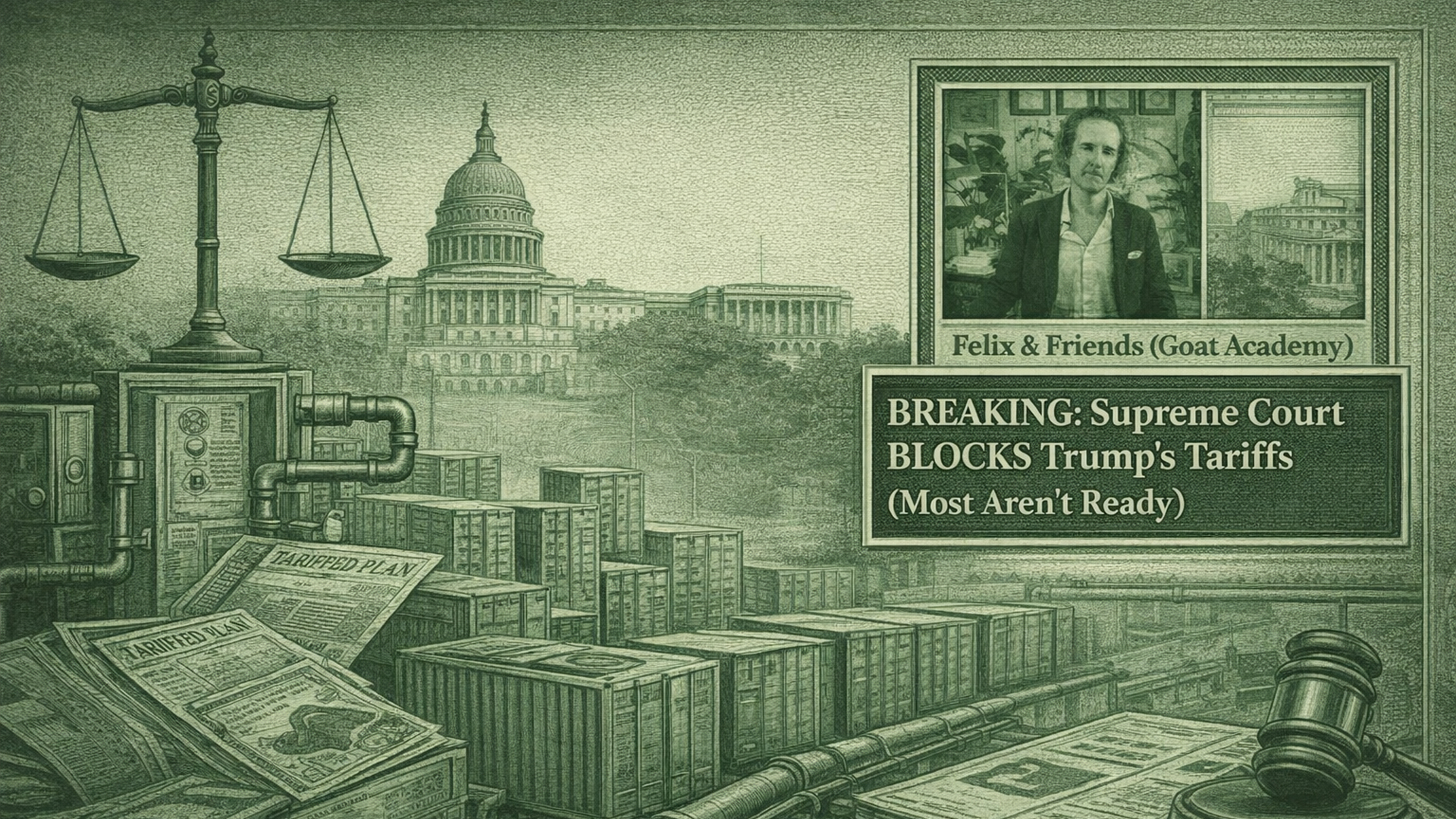
A recent United States Supreme Court ruling affecting the legal basis of several tariffs has triggered a rapid market response. Many investors interpreted the decision as a reduction in trade friction and therefore a modest reduction in inflation pressure.
However, the ruling did not remove tariffs entirely. Instead, it invalidated the legal mechanism used to impose a portion of them. Within hours, a new tariff structure was introduced under a separate trade statute that allows temporary tariffs lasting approximately one hundred fifty days unless Congress authorizes a longer implementation.
The practical outcome is not a clean removal of tariffs. Instead, the system shifted from stable tariffs to temporary tariffs with heightened policy uncertainty. Markets initially responded to the inflation relief channel, but the uncertainty channel may take longer to price.
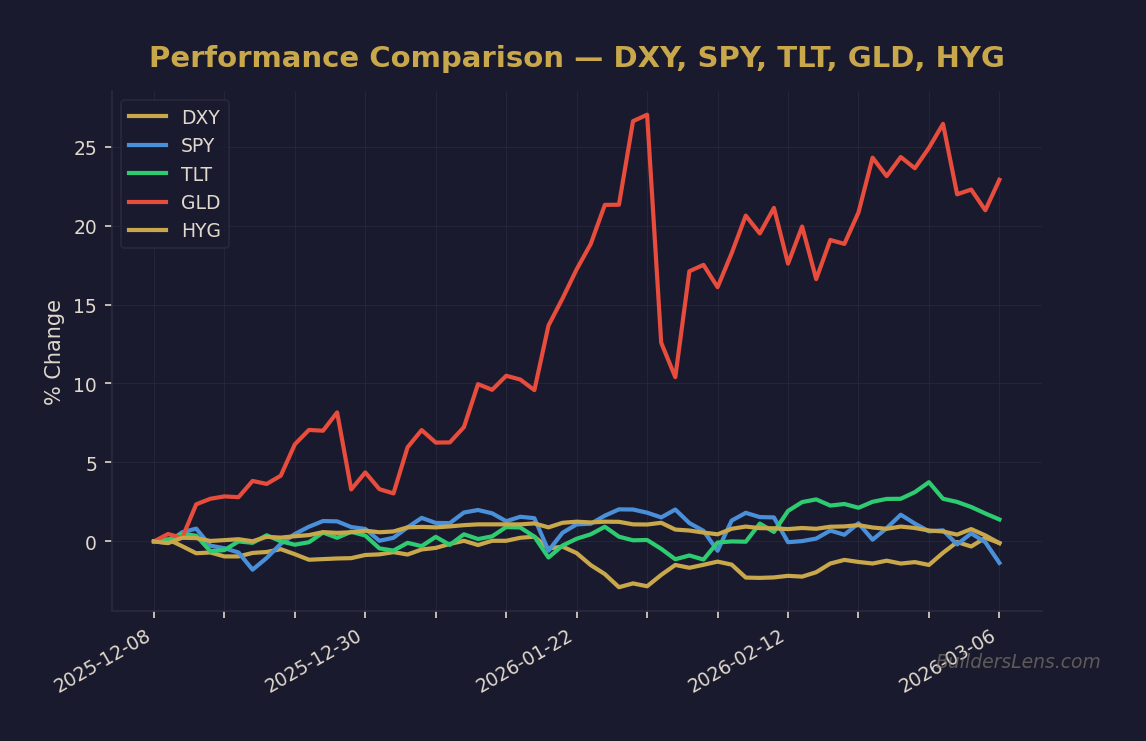
Source: BuildersLens.com Signal Framework | Data as of March 08, 2026
Mechanism Pathway: From Tariffs to Financial Conditions
Tariffs influence the macroeconomic environment through a sequence of transmission mechanisms.
- Tariffs raise the cost of imported goods.
- Higher import costs contribute to goods inflation.
- Higher inflation pressures central banks to maintain restrictive policy.
- Restrictive policy tightens financial conditions.
- Tighter financial conditions affect credit availability, corporate investment, and equity valuations.
If tariffs decline, the process can reverse. Lower import costs reduce inflation pressure and can increase the probability of easier financial conditions.
However, uncertainty can disrupt this sequence. Temporary policy changes create difficulty for corporations attempting to plan supply chains, investment decisions, and pricing strategies. In that environment risk premiums may rise even if tariff levels decline.
Second-Order Effects Markets May Be Underestimating
The most important effects often appear after the initial headline reaction.
Three transmission channels are particularly important:
- Inflation expectations: Lower tariffs may modestly reduce goods inflation if sustained.
- Interest rate expectations: Lower inflation pressure can increase expectations for easier financial conditions.
- Currency dynamics: If inflation falls and monetary policy expectations ease, the dollar may weaken, improving global liquidity conditions.
However, if long-term interest rates remain elevated and the dollar strengthens instead, markets may be pricing fiscal pressure and policy uncertainty rather than inflation relief.
Mapping the Event to Our Strategy Framework
Within Our Strategy’s macro regime model, global markets still exhibit characteristics consistent with a late-cycle environment.
Current Phase: Melt-Up Participation with Structural Fragility
Markets continue to show resilience despite rising policy uncertainty and elevated leverage conditions. Liquidity conditions remain supportive but increasingly fragile.
- Equity leadership remains concentrated.
- Credit conditions remain stable but sensitive to refinancing pressure.
- Policy shifts increasingly drive market reactions.
The tariff ruling functions primarily as a policy signal rather than a structural macro shift.
Probability Timeline Under Our Strategy Framework
Phase One — Melt-Up Participation
Estimated probability of continuation through June twenty twenty six: approximately sixty percent.
This phase can persist while liquidity conditions remain supportive and credit spreads remain contained.
Phase Two — Multiple Compression and Rotation
Estimated probability window expanding through December twenty twenty six: approximately thirty percent.
This phase typically occurs when liquidity stalls and policy uncertainty increases, leading to equity multiple compression even if economic data remains stable.
Phase Three — Forced Liquidity Event
Highest probability window currently appears between late twenty twenty six and early twenty twenty seven.
This phase historically emerges when refinancing pressure, fiscal deficits, and credit stress converge.
Phase Four — Policy Stabilization
Following a forced liquidity event, policy response and liquidity expansion typically stabilize financial markets.
Signals to Monitor
Our Strategy focuses on observable signals rather than predictions.
- Bond yields and term premium trends
- Credit spreads and refinancing conditions
- Dollar strength and global funding conditions
- Equity market breadth and concentration
- Import price inflation data
The interaction of these signals will determine whether the tariff ruling functions as a stabilizing force or as an additional catalyst for late-cycle volatility.
What Has Changed
- The legal authority supporting a portion of tariffs has been invalidated.
- Trade policy uncertainty has increased.
- Markets briefly priced the inflation relief channel.
What Has Not Changed
- The late-cycle macroeconomic environment.
- Credit market sensitivity to refinancing pressure.
- The importance of liquidity conditions in determining market outcomes.
Monitoring Assets for Signal Observation
- SPY — broad equity market sentiment
- TLT — long-duration bond response to inflation expectations
- DXY — global dollar funding conditions
- SMH — semiconductor sector concentration and momentum
- Gold — monetary hedge and policy risk indicator
These assets are monitored as indicators of regime changes rather than as trading signals.
Conclusion
The Supreme Court tariff ruling demonstrates how sensitive late-cycle markets are to policy adjustments. Even modest changes to trade policy can influence inflation expectations, interest rate projections, and currency dynamics.
For Our Strategy, the primary focus remains on sequencing rather than interpretation. The signals appearing in rates, credit markets, and foreign exchange will determine whether the system stabilizes or begins transitioning toward the next phase of the cycle.
In late-cycle environments, mechanisms matter more than headlines.
📊 Run Your Own Analysis
Use the BuildersLens 65-Signal Analyzer to see live macro positioning for tickers mentioned in this article:
→ Analyze TLT (Long-Term Treasuries)
This article is for educational and informational purposes only and does not constitute investment advice. Past performance is not indicative of future results. Consult with a qualified financial advisor before making investment decisions.