Research · Risk & Optionality
When Prices Outrun Cash Flow: Rotation, Fragility, and Market Internals

In Our Strategy, we use a five-phase cycle framework to translate market motion into phase-sequenced probabilities, not forecasts. We emphasize mechanisms over narratives, confirmations over anticipation, and optionality over certainty. The goal is not to “call the top,” but to recognize when fragility is rising and when the payoff distribution is shifting.
What the video is actually claiming
The interview’s core claim is that large-cap, cap-weighted equity indexes look expensive because prices have grown faster than free cash flow. The implication is not that markets must break immediately, but that we are entering a regime where the market may begin to punish stretched cash-flow math, especially if investor confidence in large-scale AI capital spending weakens.
How Our Strategy translates this into signal buckets
We translate the conversation into signals that can be monitored and confirmed over time, rather than conclusions to be acted on immediately.
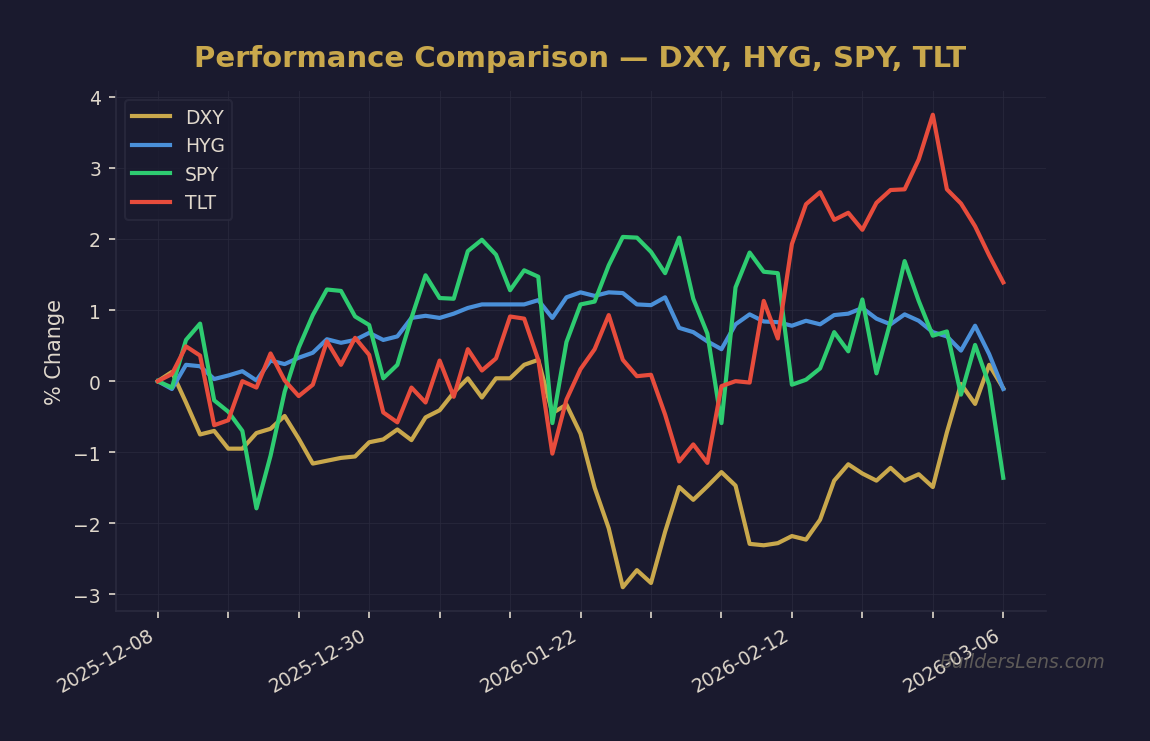
Source: BuildersLens.com Signal Framework | Data as of March 08, 2026
- Breadth and concentration: A cap-weighted index can remain elevated even as leadership narrows or rotates.
- Valuation and multiple compression: If price outruns free cash flow, the adjustment can arrive through valuation compression even without an earnings collapse.
- Capex uncertainty: Heavy investment can depress near-term free cash flow and increase fragility if returns remain uncertain.
- Liquidity and positioning: Flows can delay repricing, which is why Our Strategy waits for confirmation rather than narrative alignment.
- Credit as confirmation: Phase transitions become more serious when credit spreads widen and refinancing stress rises.
- Rates and term premium: Policy easing does not guarantee long-end easing; long rates can stay sticky even while the front end falls.
- Dollar and global funding: Dollar weakness can support commodities and non-US assets; dollar strength can tighten global conditions.
Mechanism: why “math starts to matter”
Here is the transmission chain we care about. This is not a prediction. It is the mechanism by which a market can reprice after long periods where price has outrun fundamentals.
- Expectations inflate prices. When a small group of leaders dominates performance, the index inherits their valuation sensitivity.
- Capex compresses free cash flow. If the largest firms ramp spending, free cash flow can fall even while revenue grows.
- Skepticism changes the multiple. When investors doubt future returns on spending, the multiple they are willing to pay compresses.
- Leadership breaks first. Concentrated leadership often becomes the first transmission channel for drawdowns.
- The index follows mechanically. Cap-weighted indexes can reprice sharply once the top weights roll over.
Importantly, this does not require an immediate recession. Multiple compression can occur in a “still okay” economy. That is why Our Strategy treats valuation stretch as Phase Two pressure, not as a Phase Four crash call.
Why markets can delay pricing
Markets can ignore stretched cash-flow math longer than fundamentals suggest. Passive flows, buybacks, and narrative momentum can create a timing asymmetry where price remains supported while fragility rises underneath. In Our Strategy, that asymmetry does not trigger a forecast. It triggers discipline: tighter exits, more selective exposure, and preserved optionality for volatility windows.
Phase mapping in Our Strategy
We map the interview’s ideas into phase pressure rather than outcomes.
- Phase One: Melt-up participation can persist if liquidity stays supportive and breadth broadens sustainably.
- Phase Two: Rotation and valuation compression become more likely as leadership concentration rises and cash-flow multiples stretch.
- Phase Three: Escalation requires confirmation in credit and funding conditions, not just valuation discomfort.
- Phase Four: Forced-liquidity dynamics appear only after stress becomes non-linear and policy meets market constraints.
- Phase Five: Stabilization follows after credit and liquidity stop deteriorating, not before.
Probability framing with date-anchored monitoring windows
We use calendar anchors as monitoring windows, not promises. Probabilities describe phase pressure based on current signals and can shift as confirmations appear or fail.
As of February 2026
- Phase One continuation: 45 to 60 percent
- Phase Two rotation or compression next: 30 to 45 percent
- Phase Three escalation within the next year: 15 to 30 percent
- Phase Four forced-liquidity window within the next 18 months: 10 to 20 percent
June 2026 window
By June 2026, the key question is whether rotation stays orderly, consistent with Phase Two, or begins transmitting into credit, consistent with Phase Three. If breadth improves and credit stays calm, Phase One can persist longer than valuation logic suggests.
December 2026 window
By December 2026, if capex skepticism rises and leadership fails to recover, valuation compression can deepen even without a severe macro downturn. If spreads widen persistently or funding stress appears, Phase Three probability rises.
June 2027 window
By June 2027, if the cycle has moved into Phase Three or Phase Four dynamics, the opportunity set typically shifts from careful participation to more systematic deployment once stress confirms and then stabilizes. If not, we treat it as an extended policy-delay regime with ongoing rotation risk.
What changes in Our Strategy
We do not respond to this setup with one big decision. We respond by changing the way we evaluate risk and confirmation.
- We treat concentration as fragility: We increase respect for leadership rollover risk in cap-weighted indexes.
- We tighten exit discipline: In Phase Two pressure, we prefer predefined invalidations over narratives.
- We respect rotation signals: We watch where strength broadens or fails to broaden instead of trusting index headlines.
- We preserve optionality: Optionality is the right to act when volatility delivers better odds, not an attempt to time a top.
- We demand confirmation for escalation: Phase Three requires credit and funding confirmation, not just valuation discomfort.
What does not change
- We do not call tops based on valuation alone.
- We do not assume one theme controls the entire cycle.
- We do not confuse volatility with confirmation.
- We do not deploy in one tranche; we think in phases.
- We do not replace signals with narratives, even compelling ones.
What to watch next
Our Strategy’s monitoring list focuses on confirmations versus invalidations.
- Breadth: Does leadership broaden sustainably or does concentration tighten again.
- Credit spreads: Do spreads remain contained or widen persistently.
- Liquidity smoothness: Do funding conditions remain calm or does friction return.
- Rates direction: Do long yields stall and roll over or grind higher and pressure multiples.
- Dollar trend: Does dollar weakness persist and loosen global conditions or reverse into a tightening impulse.
- Capex skepticism in price action: Do large-cap “investment stories” begin getting punished or remain rewarded.
Invalidation conditions
We reduce Phase Two and Phase Three pressure if we see clear evidence that the underlying math is improving and the market is broadening.
- Cash flow catching up to price through re-acceleration in free cash flow and stable margins.
- Sustained breadth improvement that reduces concentration fragility.
- Credit staying calm even through volatility spikes, with no persistent spread widening.
- Liquidity re-accelerating in a way that supports Phase One continuation.
Source note and educational disclaimer
This analysis is based on the interview hosted by Thoughtful Money with Adam Taggart featuring Chance Finucane of Oxbow Advisors.
Original video reviewed: https://www.youtube.com/watch?v=LgHodCHq9-0
Educational disclaimer: This is educational content only and not financial advice. Our Strategy is a probability-based framework for interpreting macro signals and sequencing risk, not a set of directives.
Get the Daily Phase Brief
Signal changes, data releases to watch, and today’s regime assessment — delivered every morning before market open.
Join investors tracking the macro cycle. Unsubscribe anytime.
📊 Run Your Own Analysis
Use the BuildersLens 65-Signal Analyzer for live macro positioning:
→ Analyze HYG (High Yield Credit)
→ Analyze DXY (US Dollar Index)
This article is for educational and informational purposes only and does not constitute investment advice. Past performance is not indicative of future results. Consult with a qualified financial advisor before making investment decisions.