Research · Market Internals
Why calm markets can be the wrong signal
Markets often look most stable right before internal conditions begin to shift. That is not a prediction of a drawdown.
It is a sequencing observation. Late-cycle environments can keep price supported through positioning, buybacks, and
volatility compression, while the underlying signal stack quietly changes.
In Our Strategy, we do not begin with outcomes. We begin with mechanisms, signal confirmation, and phase pressure.
The goal is not to be early. The goal is to remain adaptive as conditions evolve.
What we are translating from the source discussion
The source video focuses on lead indicators and flow behavior: labor softening, volatility falling, breadth improving,
and a rotation toward defensive leadership. Instead of repeating the narrative, we translate these into a
probability-based, phase-sequenced framework that emphasizes confirmation over conviction.
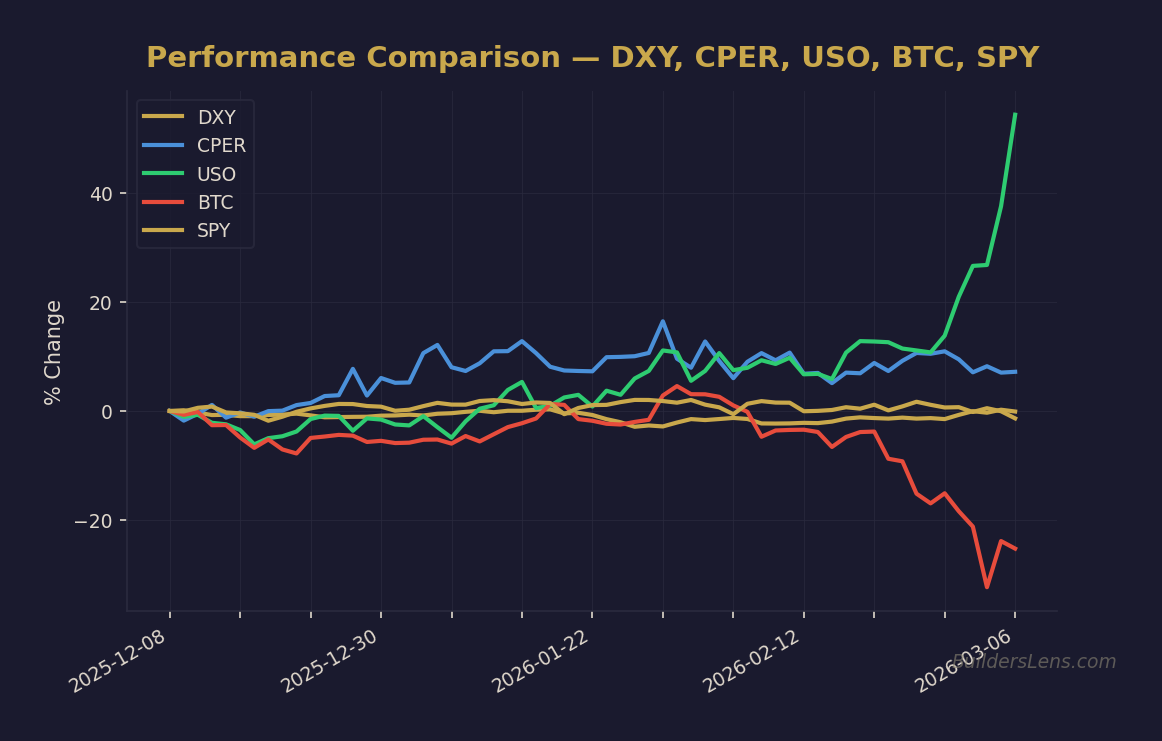
Source: BuildersLens.com Signal Framework | Data as of March 08, 2026
Our Strategy framework lens
Our Strategy uses a five-phase cycle model to organize risk and opportunity without relying on a single forecast.
Phase labels are less important than what the signals are doing. The key is sequencing: which pressures are rising,
which are fading, and what tends to follow historically once confirmation arrives.
In this note, we map the discussed signals into late Phase One behavior with rising Phase Two pressure. This framing
can remain true even if index levels continue to rise.
Signal bucket 1: labor softening is slow but decisive
Labor rarely flips markets on one data print. Its value is in persistence. When hiring slows and unemployment trends
upward, income growth typically cools next. That transmits into consumption, then margins, then earnings expectations,
then credit behavior.
The mechanism matters more than the headline. Labor deterioration is not a timing tool. It is a pressure signal that
becomes increasingly important if it continues.
Why markets often ignore labor early
Markets can stay bid while labor softens because other forces can dominate for months. Buybacks reduce float.
Volatility compression stabilizes positioning. Options hedging can dampen pullbacks. The result is an environment
where labor pressure rises, but price does not immediately reflect it.
Signal bucket 2: volatility falling does not mean risk falling
The source discussion highlights a volatility decline and a regime that looks calmer. In Our Strategy, lower volatility
can be a positioning artifact rather than a fundamental improvement. It can signal reduced realized movement while
increasing latent fragility.
When volatility compresses late cycle, price can grind higher, but the system may become more sensitive to shocks
because the market is no longer paying for protection. Calm can persist, but it also shortens reaction time if funding,
credit, or breadth breaks.
Signal bucket 3: breadth improvement buys time, not certainty
Breadth and participation matter because they determine how resilient the tape is to negative surprises. If
advance-decline trends improve and more stocks participate, the market can stay supported even when macro narratives
deteriorate.
However, breadth is also one of the cleanest confirmation signals when the regime turns. If breadth rolls over while
defensives lead, Phase Two pressure typically increases meaningfully.
Signal bucket 4: defensive rotation is the quiet tell
One of the more important elements in the source discussion is sector behavior. When defensives such as utilities begin
to outperform, it can indicate a shift in what the market is paying for. This is not the same as panic. It is often an
early sign of late-cycle preference for stability and yield-like cash flow characteristics.
Rotation does not require an immediate drawdown to matter. It can coexist with index strength, especially when
mega-cap support and market structure effects dominate. The practical implication is that late-cycle often becomes
more path-dependent: leadership matters as much as the index.
Signal bucket 5: rates, the dollar, and cross-asset conditionality
Rates and the dollar operate as conditions that shape the entire opportunity set. If yields stall or drift lower,
duration becomes less of a headwind and rate-sensitive groups may stabilize. If the dollar strengthens, global funding
conditions can tighten, which often pressures global risk assets earlier than domestic indexes.
Our Strategy treats these as confirmation channels. We do not need to predict where yields or the dollar go. We need to
observe whether they reinforce or contradict what equities and credit are implying.
Signal bucket 6: commodities as fiscal and inflation persistence sensors
The source discussion references copper and oil behavior as part of the broader macro read. We treat industrial
commodities as a blend of inflation persistence and fiscal impulse signals. Government expenditure and infrastructure
cycles can keep real-economy demand sticky even when private demand begins to soften.
This is one way late cycle can look like growth for longer than expected, while risk density still rises beneath the
surface.
Signal bucket 7: crypto as liquidity beta, not a narrative
The source discussion frames bitcoin through technical structure and a potential basing process. In Our Strategy, we
treat bitcoin primarily as liquidity beta: it tends to respond to easing financial conditions and can struggle when
funding tightens.
That makes crypto useful as a regime sensor. It is less useful as a standalone macro thesis.
Phase mapping and probability framing
Putting the stack together, we frame the current regime as late Phase One behavior with rising Phase Two pressure.
That means continued strength remains plausible, but the distribution of outcomes becomes more dependent on
confirmation from credit, funding, and breadth.
Date-anchored probabilities (conditional, not predictive)
June 2026: Phase One continuation at 40 to 55 percent. Phase Two pressure rising at
35 to 50 percent. Phase Three risk at 10 to 20 percent.
December 2026: Phase One at 20 to 35 percent. Phase Two at 35 to 50 percent.
Phase Three at 20 to 35 percent. Phase Four at 5 to 15 percent.
June 2027: Phase Two at 25 to 40 percent. Phase Three at 25 to 40 percent.
Phase Four at 10 to 25 percent. Phase Five at 15 to 30 percent.
These probabilities are designed to enforce humility and sequencing discipline. They are not a forecast. They are a
structured way to size uncertainty and avoid single-path conviction.
What changes in Our Strategy and what does not
What changes
As defensive leadership and labor softening become more visible, we raise the bar for confirmation. We also treat
volatility compression as a potential fragility signal rather than reassurance. Finally, we become more sensitive to
cross-asset contradictions, especially credit and funding conditions.
What does not change
We do not make all-in bets off one indicator. We do not confuse index strength with broad health. We preserve
optionality, and we allow confirmation to pull us through phase transitions instead of forcing a timing call.
What we watch next: confirmations and invalidations
Confirmations we want to see
- Labor softening remains contained rather than accelerating.
- Credit stays stable and does not begin a persistent widening trend.
- Breadth remains durable and leadership continues to broaden.
- Yields stall or drift down without a funding stress impulse.
- The dollar does not enter a sustained tightening squeeze.
Invalidations that reduce this framework weight
- Labor re-accelerates sustainably and hiring breadth improves.
- Defensive outperformance fades while cyclicals lead with broad participation.
- Credit remains contained through equity pullbacks without stress propagation.
- Funding indicators remain calm even as volatility normalizes.
Observation-only tickers: SPY, VIX, TLT, DXY, XLU, XLF, XLE, GLD, HYG, IWM, QQQ.
Educational disclaimer
This content is for educational purposes only and is not financial advice. We are describing macro mechanisms and
signal behavior, not providing recommendations.
Close
Late cycle is rarely clean. Markets can remain supported while internal conditions shift. Our Strategy response is to
stay conditional, track confirmations, and protect optionality. We do not need certainty. We need sequencing discipline.
Get the Daily Phase Brief
Signal changes, data releases to watch, and today’s regime assessment — delivered every morning before market open.
Join investors tracking the macro cycle. Unsubscribe anytime.
📊 Run Your Own Analysis
Use the BuildersLens 65-Signal Analyzer for live macro positioning:
This article is for educational and informational purposes only and does not constitute investment advice. Past performance is not indicative of future results. Consult with a qualified financial advisor before making investment decisions.